Posts Tagged book review by Amy Steele
book review: Lady Cop Makes Trouble
Posted by Amy Steele in Books on December 19, 2016
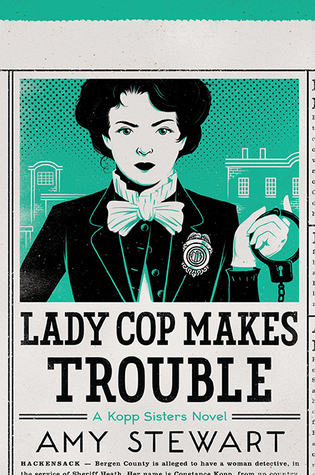 Lady Cop Makes Trouble by Amy Stewart. Houghton Mifflin Harcourt| September 2016| 320 pages | $26.00| ISBN: 978-0-544-40994-1
RATING: ***/5*
This was an overall fun and enjoyable read. I didn’t read the debut Kopp Sisters novel Girl Waits with Gun so maybe it wasn’t a good idea to read the second book. I do think that even in a series each book should be a stand-alone that anyone can pick up to read and figure out what’s going on. Despite not knowing the case from the first novel which did carry over to this novel–at least in consequences for Constance Kopp and her position as deputy sheriff—I could mostly piece together what I needed. The youngest sister Fleurette confused me at first and I didn’t know if she was a daughter or niece. I absolutely admire and appreciate that Amy Stewart found clips in which to base this case and that Constance Kopp was a real person. Stewart explained, “I’m lucky enough to have a huge treasure trove of newspaper clippings covering 1914 and 1915. Constance was in the paper all the time. This book covers one particular incident that made headlines nationwide: the pursuit of a convicted criminal.” This is a delightful description of Constance’s duties for the New Jersey sheriff’s department: “I wasn’t just a chaperone for wayward girls. I carried a gun and handcuffs. I could make an arrest, just like any deputy. I earned a man’s salary. People did find it shocking and I didn’t mind that one bit.” Constance stands as a strong, determined female working in the male-dominated field of law enforcement. She doesn’t seem deterred when men don’t know how to speak with her or how to react to her as she carries out her varied responsibilities. She lives with her sisters, Fleurette and Norma, in the countryside in New Jersey. Norma seems content to raise homing pigeons and not venture far from home. Fleurette dreams of the stage and for now acts in a local production. The sisters look out for one another and serve as sounding boards for each other. Not having sisters it seems a wonderful thing. This case didn’t quite enthrall me enough for a mystery/thriller, fortunately the strong female lead makes up for my lack of interest and sometimes confusion in the case. I rooted for Constance and her sisters to fight the system and to fight sexism.
–review by Amy Steele
FTC Disclosure: I received this book for review from Houghton Mifflin Harcourt.

Share this:

book review: Virgin and Other Stories
Posted by Amy Steele in Uncategorized on December 15, 2016
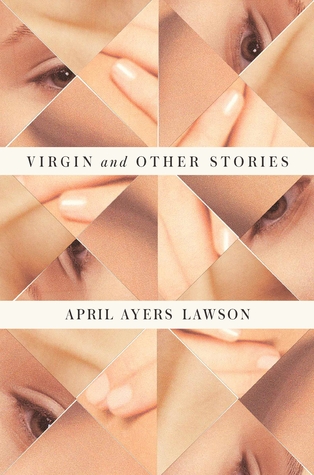
Virgin and Other Stories by April Ayers Lawson. Farrar, Straus and Giroux| November 2016| 179 pages | $23.00| ISBN: 9780865478695
RATING: ****/5*
Strong debut short story collection with a dark tone and dark sense of humor. Author April Ayers Lawson, currently a visiting writer at University of North Caroline at Chapel Hill, grew up in the South with an evangelical background. She grew up in Greenville, South Carolina. It’s easy to imagine that everyone in the South drives around in a pick-up truck with confederate flag and gun rack attending weekly church service. In this story collection she creates a complex image of the South and its inhabitants with rich details and enthralling, layered characters.
In the title story, Jake contemplates the potential deterioration his marriage to Sheila, a virgin when they wed. A teenager becomes tantalized by a mysterious young man living at her piano teacher’s home in “The Way You Must Play Always:” “The love inside her had room to spread out now. It was part nervousness, part desperation, and a little craziness too, and she felt it begin to rush outside of her and around her, leaving invisible prints of itself all over the things she touched: her bag, her books, the keys, the pages of the music she turned.” A woman who befriended a transgender woman at her church takes her son to the woman’s funeral in “The Negative Effects of Homeschooling.” This boy recalls how different his mother would be when Charlene would come over to visit: “First I thought WHAT IN THE WORLD did my mother have to put in a diary? All she did was give me assignments, wander around the house wiping things down, drink green tea, and go to stores. She never said anything to me about a diary; then Charlene’s her thirty minutes and my mom is Anne Frank.”
In the best story, a married artist forms complicated relationships with her art dealer and another artist in “Vulnerability.” She’s married to a man who mostly hangs out after work in the garage watching porn on his computer. Of her husband: “Occasionally when I returned from the bathroom at a restaurant I’d come back to find him engaged more happily in conversation with the waitress than he ever was with me; with me he claimed he could be himself, which was depressed.” She creates imaginary relationships in her mind then when she meets the art dealer and another man she corresponded with she plays them off against each other. There’s a dangerous precariousness in her emotions and palpable insecurities: “I knew I had nice legs, and unable to think of anything funny or intelligent to say, my mind sludgy with the clonazepam I chewed like candy and alcohol and th dregs of crumbling fantasy, I shifted then about in hopes that he’d forgive me for not being as smart and inspired and bold as I thought I’d managed to seem in the emails.” Best read slowly to savor and absorb the exquisite details.
–review by Amy Steele
FTC Disclosure: I received this book for review from Farrar, Straus and Giroux.
Share this:

book review: Mister Monkey
Posted by Amy Steele in Uncategorized on November 15, 2016
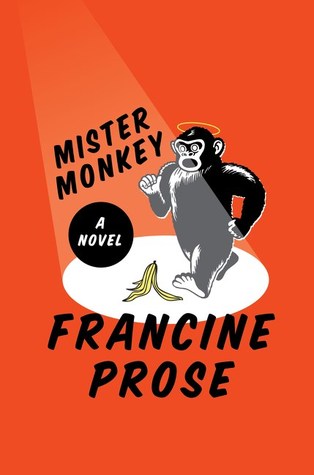
Mister Monkey by Francine Prose. Harper| October 2016| 285 pages | $26.99| ISBN: 978-0-06-239783-6
RATING: ****/5*
“They are in this together, everyone is happy to be here and disappointed to be here, glad to have a part in a play, glad to work for scale, but truthfully not all that overjoyed to be working in an off-off-off-off-Broadway production of Mister Monkey, the umpteen-hundreth revival of the cheesy but mysteriously durable musical based on the classic children’s novel.”
In writing this novel about a failing theatrical production, author Francine Prose [Lovers at the Chameleon Club: Paris, 1932, My New American Life, Blue Angel] addresses the rippling effect of the play on a bevy of players. The faltering stage production of a classic and popular children’s novel brings together a disparate group of actors, crew and audience members. Prose imagines how this rather basic play correlates to the mid-aged actress questioning her career, the child actor playing the titular monkey, the children’s book author and young child in the audience, that child’s teacher and others. Each chapter builds on the past one. The play’s based on a novel about a wealthy New York family who adopts an orphaned monkey. The father’s girlfriend thinks the beloved monkey stole her wallet. The case ends up in court. Absurdity ensues.
Each chapter addresses the play from a different character’s viewpoint adding more layers to the story behind the play. Margot wonders how she ended up working so hard and not advancing her career in the way she’d imagined. She’s playing Mister Monkey’s lawyer in a tiny theater. This isn’t the career she’d envisioned for herself at Yale. She reminds herself: “Art is art, theater is magic, no matter how humble the venue. Together they have transformed a house full of strangers into a group of people all rooting for Mister Monkey!” The home-schooled twelve-year-old actor in the monkey suit became engulfed in everything simian when he landed the role. He also harbors a massive crush on Margot. Costume designer Lakshmi believes “Mister Monkey is a nasty piece of imperialist propaganda justifying human trafficking, which you would know if you were smart enough to substitute a person for a monkey.” Eleanor works as a nurse full-time and acts on the side. The grandfather and his grandson, Edward, attended a matinee of the play. Prior to the play the grandfather started reading the book to his grandson. “The grandfather didn’t like the book either. It seemed obvious and preachy, full of improving lessons about race and class, honesty, justice, and some kind of . . . spirituality, for want of a better word.” Edward takes the playbill to school and a spirited argument about evolution erupts among the kindergartners.
How does this affect Edward’s teacher Sonya? She’s in trouble because her young pupils discussed Darwinism. Sonya meets a guy for dinner at a fancy restaurant where she ends up next to the book’s author. The date deteriorates quickly. Suffering from PTSD after Vietnam, Ray ending up writing Mister Monkey based on an experience during the war. He’s now wealthy. Whenever Ray receives theatrical royalties he takes whomever he’s dating or married to at the time to dinner at a restaurant called Enzo’s and he gives his favorite waiter Mario tickets to the production. Mario’s fiancée left him—“She was the one who pretended to be someone else, someone who wanted a life of simple contentment with Mario. By then Mario had moved back to his parent’s house for what he’d thought would be a few weeks.” Mario adores the theater and will attend any play and restaurant patrons gift him tickets often.
Prose based the novel on her own experience attending a children’s musical with her granddaughter at a small theater in Manhattan. Prose found the production lacking and tragic and at one quiet moment her granddaughter exclaimed: “Grandma, are you interested in this?” And so Prose wrote this novel to address that question. Fascinating connections allow Prose to explore shattered dreams, unfulfilled goals, success, failure, raising a child in Manhattan, career, love and friendship through wonderful characterizations, vivid prose and a sharp tone. It’s easy to become engulfed in this brilliant, darkly amusing and astutely observational novel.
FTC Disclosure: I received this book for review from Harper Collins.
–review by Amy Steele

Share this:

book review: Pull Me Under
Posted by Amy Steele in Books on November 2, 2016
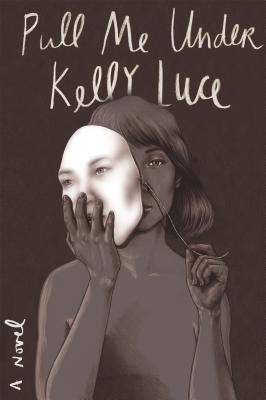
Pull Me Under by Kelly Luce. Farrar, Straus and Giroux| November 2016| 272 pages | $26.00| ISBN: 9780374238582
RATING: *****/5*
At the novel’s beginning, twelve year old Chizuru Akitani, the Japanese American daughter of acclaimed violinist Hiro Akitani, fatally stabs a classmate. She’s bullied in school for one of the most common reasons children tease other children, she’s different– she’s a hafu—Japanese for mixed blood [“Hafu implied my Japanese-ness was the only part of me that mattered, that there would never be enough.”] and fat. Her American-born mother commits suicide. Her father didn’t spend that much time with her (or her mom). She suppressed anger for as long as she could until she was pushed too far by the bully. It’s explained like this: “I noticed at a young age—four years old, five—a dark presence in my chest, a blackness, clinging to the back of my heart. Mostly the thing lay dormant and I could put it out of my mind. But occasionally it swelled like an infected gland. These were the times I felt hurt or angry, the sensations so closely linked that I never separated them until a therapist pointed out the difference. My anger was an organ.”
The haunting story unfolds methodically revealing details. Chizuru serves time in a juvenile detention facility, must denounce her Japanese citizenship, changes her name to Rio and moves to the United States to attend college. She reinvents herself while rarely looking back on her past. Rio strives to blend in and succeeds. This seems quite a positive and mindful manner in which to exist. Rio becomes a runner—“I’d found a way to soothe that curdled feeling of anxiety; when I ran, the bad things fell away.” She becomes a nurse, marries her college boyfriend and has a daughter. She’s the good wife, good mother, and good employee. Of her life in Colorado: “I feel like what I am: a thirty-eight-year-old mother and wife with a retirement fund and a house in the suburbs and a Volvo. My life has been built for safety.” While in the United States, many might present several various facades for various relationships or settings, there’s a name for it in Japan—“Interactions revolve around honne and tatemae. Honne is what you really think and feel; tatemae, like the façade of a building, is the face you show to the world.” Globally, women are expected to suppress emotions, feelings and thoughts. Perhaps more so in Japan than in the United States although it’s clear per societal standards and the general zeitgeist that outspoken women and poorly behaved women rarely get rewarded compared to male counterparts.
Decades later, Rio returns to Japan to reconcile her present with her past and perhaps embrace forgiveness. Her husband and daughter know nothing about her past. Rio reflects: “Sal doesn’t know all of me. Maybe this is true of all husbands and wives; after all, there are inaccessible places in each of us. Places few would understand, and marriage, I’ve come to believe, is about finding someone who understands the right things without digging up the wrong ones.” At her father’s funeral she reunites with a former teacher, a New Zealand-native named Danny. When Danny says she’s going on a pilgrimage through Japan’s numerous temples, Rio decides to tag along. Along the trail, the women start hiking with a young law student named Shinobu. What Rio discovers about herself as well as her father may affect her life back in the United States.
“I can be hafu, if I want; I can always find someone to call me incomplete. But I can be whole, too; I can be unsplit and complete in the fragmented way that a life is a life.”
Pull Me Under is an exquisitely dark psychological thriller which examines identity and place through its compelling protagonist and story. It’s easy to empathize with Rio and understand her motivations to minimize her Japanese ancestry. Author Kelly Luce provides detailed descriptions –“Ryozenji is all worn stone and dark, weathered wood. A pond with a fountain sits in the middle. Goldfish swarm the edge where an old woman tosses bread. She pinches off a piece and holds it out. A white and orange spotted fish jumps fully out of the water.”–and fascinating cultural elements—“I fill my basket with the candies I loved as a kid: sesame sticks, caramel frogs, tubes of sugar decorated with astrological signs.” Every aspect of this novel creatively allows readers to become fully absorbed from beginning to end.
–review by Amy Steele
FTC Disclosure: I received this book for review from Farrar, Straus and Giroux.
Share this:

book review: Future Sex
Posted by Amy Steele in Books, Uncategorized on October 17, 2016

Future Sex by Emily Witt. Farrar, Straus and Giroux| October 2016| 210 pages | $25.00| 9780865478794
RATING: *****/5*
“I had not chosen to be single but love is rare and it is frequently unreciprocated. Without love I saw no reason to form a permanent attachment to any particular place. Love determined how humans arrayed themselves in space.”
Technology changes everything. It changes how we meet people and it changes how we interact with others. There’s more sexual fluidity and experimental sex than in the past because of both changing ideologies as well as the ability to remain anonymous online if one chooses to indulge in one’s fantasies. Whatever you fancy you’re likely to find it. However, society still expects people to couple up to have families. Author Emily Witt writes: “If every expression of free sexuality by a woman would be second-guessed, it left men as the sole rational agents of sexual narrative. The woman was rarely granted the heroic role of seducer. If a woman pursued a strictly sexual experience, she was seen as succumbing to the wishes of the sovereign subject.” We live in a rampant rape culture. Women also get slut-shamed for wanting and pursuing sex. Can someone subsist outside of a monogamous relationship? Does everyone need to be part of a couple? This book strongly suggests that it’s not essential although how far outside the cultural norms must one go to be happy? Witt explains: “I supposed that since then I had been nonmonogamous in the sense of sometimes having sex with several different people within a specific period of time. As I said this both the idea of counting people and the idea of grouping them within a time frame seemed arbitrary. This was just my life: I lived it and sometimes had sex with people. Sometimes I wanted to commit to people, or they to me, but in the past two years no such interests had fallen into alignment.” Future Sex reads as a fascinating sociological study on sexuality that delves into orgasmic mediation, internet porn, webcams, Burning Man and polyamory. Witt combines personal experience with research and reporting in a darkly amusing, honest and real manner. Witt investigates sites I’d barely heard of: Chaturbate; Porn Hub; Kink.com; Fetlife. She attends an orgasmic mediation workshop [looked up on YouTube and there are tutorials] and travels to Burning Man. She interviews tons of people such as polyamorous Google employees, the founder of OKCupid, a 19-year-old webcammer as well as a woman who creates female-centered porn. Witt doesn’t make a spectacle of what may be absurd. Instead she writes analytically, astutely with brevity and a sharp edge.
–review by Amy Steele
FTC Disclosure: I received this book for review from Farrar, Straus and Giroux.
Emily Witt will be at Harvard Book Store on Monday, October 17, 2016
Share this:

book review: We Were Feminists Once
Posted by Amy Steele in Books on October 11, 2016
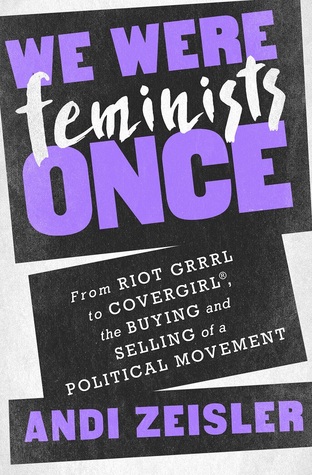
We Were Feminists Once by Andi Zeisler. Public Affairs| May 2016| 285 pages | $26.99| ISBN: 9781610395892
RATING: ****/5*
Andi Zeisler, founding editor of Bitch Media, provides a history of feminism in mainstream pop culture and whether or not it benefits the feminist movement. She writes: “This increasingly looks not like a world that has finally emerged into fully realized feminism, but like a world in which we are letting a glossy, feel-good feminism pull focus away from deeply entrenched forms of inequality.” In the past few years, legislators in various states have decreased women’s health care and threatened women’s right to make choices about their own bodies, sexuality and chose whether or not to give birth. Women do not have pay equity. Must I even mention this country’s prevalent rape culture? I list feminist on my social media bios and my dating profiles. So there are questions such as: “what type of feminist are you?” and “do you shave your legs/armpits etc?” and comments such as “no wonder you can’t get/keep a man.” I could go on but won’t. Zeisler delves into advertising, film, television, music. Meticulously researched, analyzed and thoughtfully presented, this is a must-read.
On film: “If there’s any silver lining here, it’s that more people than ever are talking about Hollywood’s woman problem as pattern behavior, rather than movie-by-movie shortcomings.”
On “this is what a feminist looks like” t-shirts: “The appeal of the slogan was easy to interpret: after all, too many people find the biggest roadblock to embracing feminism is in its unflattering optic legacy. Hags, dykes, ugly, unshaven, angry, finger-pointing, furious women—such adjectives and images have been encoded as the truth of what ‘feminism’ represented for so long that it’s begun, sadly to feel natural.
On celebrity feminism: “The fascination with Beyonce’s feminism, the urge to either claim her in sisterhood or discount her eligibility for it, speaks to the way that a focus on individuals and their choices quickly obscures the larger role that systems of sexism, racism, and capitalism play in defining and constraining those choices.”
–review by Amy Steele
FTC Disclosure: I received this book for review from Public Affairs.
Share this:

book review: Commonwealth
Posted by Amy Steele in Books on October 8, 2016
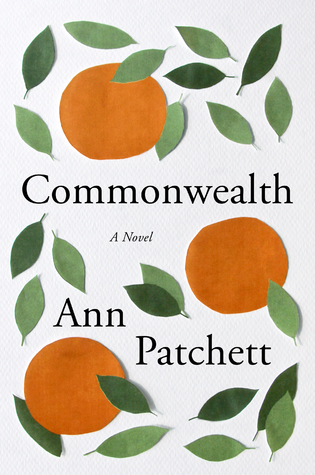
Commonwealth by Ann Patchett. Harper| September 2016| 241 pages | $27.99| ISBN: 978-0-06-240353-7
RATING: ****/5*
What may have been an innocent kiss at a summer party leads to breaking up two families and cobbling together another in best-selling author Ann Patchett’s new novel Commonwealth. As she’s so deftly done in previous novels [Bel Canto, Run, State of Wonder] she writes humorously and movingly about seemingly disparate individuals connected by a shared experience. Bert Cousins and Beverly Keating move from California to Virginia along with Beverly’s two daughters Caroline and Franny. When the girls return from visiting their father in California, Patchett writes: “Beverly dropped to her knees to hug them but they were nothing but ghosts. Caroline wanted to live with her father. She begged for it, she pleaded, and year after year she was denied. Caroline’s hatred for her mother radiated through the cloth on her pink camp shirt as her mother pressed Caroline to her chest. Franny on the other hand simply stood there and tolerated the embrace. She didn’t know how to hate her mother yet, but every time she saw her father crying in the airport she came that much closer to figuring it out.” Oh divorce. . I’m a child of divorce but don’t have a blended family nor do I maintain relationships with my siblings or step-cousins.
Bert’s four children—Cal, Holly, Jeanette and Albie—remain with their mother but visit Virginia each summer. The six children bond over a disdain for their parents. Patchett writes: “The six children held in common one overarching principle that cast their potential dislike for one another down to the bottom of the minor leagues: they disliked their parents. They hated them.” They roam about without parental guidance and get themselves into varying degrees of trouble. The divorce of course affects each child differently. Cal, the oldest, leads the pack carrying a gun because that’s what one does in Virginia apparently. The children also give the littlest boy Albie allergy meds [telling him they are Tic Tacs] to knock him out so he won’t get underfoot. Many children of the 60s, 70s and 80s explored without constant adult supervision. A friend and I took our horses swimming in a man-made pond until the developers complained.
After Cal’s sudden death one summer, the children see less of each other. Spanning 50 years, Patchett develops the characters into adulthood where other events bring the step-siblings back together at times. Caroline, who diligently studied an LSAT book her father gave her for Christmas during childhood and her teen years, become an attorney. Jeanette lives in New York with her doctor husband. Albie is the most transient and troubled of them all. Holly escaped everything to a Buddhist community in Switzerland where she spends her days meditating. When her mom visits, Patchett paints a vivid picture of Holly’s chosen lifestyle and her mom’s discomfort yet willingness to participate in order to see her daughter. There’s much focus on Franny, who I loved. She doesn’t quite know what she wants to do with herself and to that I can definitely relate. Patchett writes: “For someone who had no skills and no idea what she wanted to do with her life other than read, cocktail waitressing was the most money she could make while keeping her clothes on.” While working, she meets the author Leon Posen, decades older than her, whom she greatly admires. They become lovers and she tells him about that summer and he writes a best-selling novel about it. Two decades later when the film version hits theaters, Franny is married with stepchildren and she and Caroline visit their father, Fix, now in his 80s and dying from cancer and take him to see the film.
The novel deftly traverses between different time periods as readers discover what happened to Cal and what everyone’s now doing as an adult. Some characters and scenes resonate more than others. It’s quite a large and unwieldy cast of characters and some of them can get lost in the pages. At times I became slightly slowed down by remembering how one character connected to another. In these characters readers will find some commonality, some connection and that makes the novel thoroughly readable and satisfying.
–review by Amy Steele
FTC Disclosure: I received this book for review from Harper Collins.
Share this:

book review: Leaving Lucy Pear
Posted by Amy Steele in Books on September 25, 2016
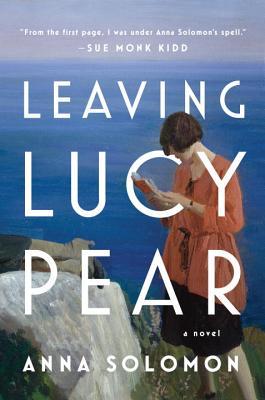
Leaving Lucy Pear by Anna Solomon. Viking| July 2016| 319 pages | $26.00| ISBN: 9781594632655
RATING: *****/5*
An engrossing and gorgeous work of historical fiction, this novel effectively weaves together issues of class, feminism, wealth, power, mental illness and motherhood. The setting: Cape Ann, Massachusetts, a working class fishing community as well as a lovely coastal summer getaway for Boston’s wealthy. In 1917, the unwed teenage daughter of a wealthy family abandons her newborn daughter under a pear tree outside her uncle’s estate on Cape Ann. A decade later, Beatrice finds herself unexpectedly reunited with the Irish woman raising the determined and spunky Lucy Pear. Emma Murphy presents a business proposal to the local quarry owner and mayoral candidate, Josiah Story, and soon the mother of nine and wife to an alcoholic fisherman finds herself involved in an affair with this wealthy man. He sets her up with a job helping Beatrice take care of her elderly uncle. Beatrice is an activist but also dealing with mental illness. She married a gay man and chooses to spend the majority of her time with her uncle on Cape Ann instead of with her husband in Boston. Author Anna Solomon writes: “She lived with her uncle instead of her husband. She didn’t play piano. She hadn’t lasted a semester at college. She had abandoned her baby! She had failed to recover.” In many ways I could relate to Beatrice and this made for compelling reading. Solomon created characters with depth and fallibility– characters in which many readers should find commonality. Lucy decides to get work alongside her brothers at the quarry by dressing as a boy. She’s determined to raise enough money to escape her abusive adopted father and move to Canada where her older brother lives. With her dark curly hair, Lucy realizes she’s different than her siblings. Solomon writes: “Emma wondered if Lucy was dumb because then keeping Lucy could pass for a kind of selflessness. But Lucy turned out not to be at all dumb, only even-tempered and kind. She had the steady energy of a woman by the time she was eight, along with a boy’s knack for physical work, for pieces and parts and how they fit together, how things worked.” A native of Cape Ann, Massachusetts, Solomon effectively creates a distinctive sense of place. Leaving Lucy Pear is an outstanding novel.
–review by Amy Steele
FTC Disclosure: I received this book for review from Viking.
Share this:

book review: Girl Through Glass
Posted by Amy Steele in Books on September 20, 2016
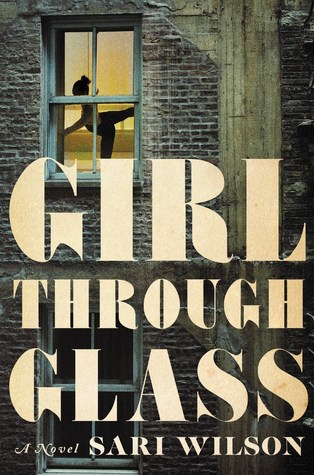
Girl Through Glass by Sari Wilson. Harper| January 2016| 304 pages | $25.99| ISBN: 9780062326270
RATING: *****/5*
Utilizing the ballet world in 1970s and 1980s New York, author Sari Wilson provides a fascinating and dark character study in her debut novel Girl Through Glass. Readers are introduced to 11-year-old Mira, a talented ballerina with immense potential. She’s forced to become savvy and self-sufficient after her mother and father divorce. Perhaps Mira develops an unusual [and rather disturbing] relationship with 47-year-old Maurice because she’s essentially without parental guidance and attention most of the time. Mira’s mom isn’t like other ballet moms – perhaps the equivalent of today’s helicopter parents—but she’s rather a free spirit occupied by her own interests rather than those of her daughter. Wilson writes: “Ballet mothers pack tiny, neatly wrapped sandwiches of sardines (good for the bones), little plastic bags of celery and carrot sticks, and yogurt with prunes.”
“But Mira’s mother makes Mira chickpea sandwiches on bread that crumbles when she touches it. Mira’s mother wears orange jumpsuits and culottes, and drops her off and leaves her to do errands, floating in at the end of class, smelling fresh and sour, lie the ocean and a cloudy day.”
Dance becomes Mira’s escape and addiction. This warps her self-esteem and sense of self. She begins investing as much time as she can to ballet and her body, even counting calories with anorexic obsession as she earns a spot at the prestigious School of American Ballet under the direction of legendary George Balanchine. At this point she’s living with her father and his new wife while her mother searches for self-fulfillment in California. While Mira might be a street-smart New Yorker she’s also still a teenager when something unimaginable shatters her idyllic cocoon.
In present day, Kate, a professor of dance and dance historian at a midwestern college. concentrates on illuminating the cutthroat world of ballet—that Black Swan-type competitive focus on perfection, being the best at all costs and winnowing out the wheat from the chaff. Kate re-invented herself after a tumultuous event and retreats into a new career although she remains involved with dance in another facet. She’s not abandoned her passion, she’s merely grown-up and into a fresher perspective on it. Kate’s liaison with a student shifts her trajectory. She also receives a mysterious letter from a man she knew in her childhood. She travels to New York to sleuth out what happened to this man who nearly destroyed her 30 years prior.
A former ballet dancer, Wilson provides intimate details about New York’s ballet scene. While this isn’t solely a novel about the ballet world, girls straddling the line between youth and adulthood provides fascinating reading. The novel flawlessly describes the razor sharp focus on becoming the best, earning a particular status and securing one’s place in this strange world overflowing with beauty and sacrifice. And what happens to all those girls who aren’t’ quite the best? Those girls who do not make the right school or earn a place in a prestigious ballet company? This absorbing, riveting novel does what a wonderful novel can do: it completely transports readers to a specific time and place in such an effective and specific manner that one thinks about the subject and characters well past finishing the last page.
–review by Amy Steele
FTC Disclosure: I received this book for review from Harper.
<a href=”http://www.indiebound.org/?aff=writergal85″><img src=”http://www.indiebound.org/files/blue-small.gif” alt=”Shop Indie Bookstores” border=”0″ /></a>
Share this:

book review: Jonathan Unleashed
Posted by Amy Steele in Books on July 27, 2016
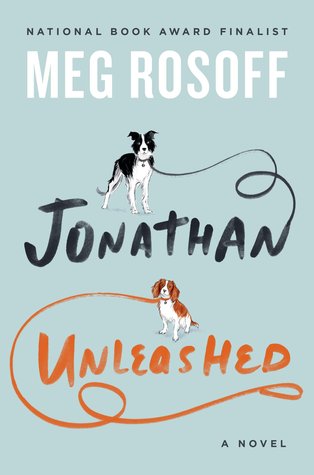
Jonathan Unleashed by Meg Rosoff. Viking| July 2016| 275 pages | $25.00| ISBN: 9781101980903
RATING: 3.5/5*
There’s an absurdist quality to this novel about a millennial taking care of his brother’s dogs and growing attached to them. Jonathan loses interest in his job and his fiancée, which he may never have been terribly attached to in the first place. Author Meg Rosoff finds much to say about ambling about mindlessly and figuring out one’s sense of place. She also adeptly and amusingly describes both millennials and hipsters. What I couldn’t bear was that the titular character Jonathan allowed things to happen around him and as a result to him without particularly caring. Excellent writing but not the best story I kept reading for the turns of phrase and superb vocabulary like “He never once mentioned the Byzantine quality of his dogs’ inner lives, the practical and spiritual difficulties of caring for other sentient beings..” also: “Once he took her out to lunch and tried to explain the ties that writers had with pens, how writing with a gel pen felt like slipping around in mud or transferring lines straight from brain to page, while a ballpoint indicated a frugal no-frills personality, someone you’d barely want to know.” Definitely worth reading for the high-quality writing.
–review by Amy Steele
FTC Disclosure: I received this book for review from Viking.
Share this:

About Me

covering mostly music and books. focus on alternative/indie and women in music, literature and the arts. feminist. vegan. mostly alternative, a bit bohemian. Masters in journalism from Boston University. BA from Simmons College.



Entertainment Realm by Amy Steele is licensed under a Creative Commons Attribution-Noncommercial-No Derivative Works 3.0 United States License.
Based on a work at entertainmentrealm.comCopyright © 2009. All writing, unless otherwise noted, by Amy Steele.
 ENTERTAINMENT REALM

You must be logged in to post a comment.