Posts Tagged book review
book review: The Muse
Posted by Amy Steele in Books on July 26, 2016
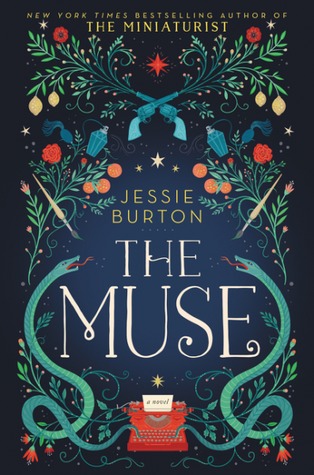
The Muse by Jessie Burton. Ecco| July 26, 2016| 416 pages | $27.99| ISBN: 9780062409928
RATING: ****/5*
Sometime I might want to read (or perhaps write) a novel from one viewpoint in one time period. Historical fiction does draw me in particularly with vivid descriptions, an established sense of place and depth of character. The Muse intrigued me by its lovely black cover, the title and the settings: 1960s London and 1930s Spain. A muse generally refers to someone who influences one’s art. Author Jessie Burton created two independent-spirited and determined women despite their circumstances and the time periods. But who’s kidding anyone? Women still have it tough in 2016. In this novel I didn’t think a muse existed. Although without giving anything away there might be an unexpected muse. Flip the expectations for a muse. This is Burton’s second art-focused historical fiction novel. The Minaturist came out in 2014. I wanted to adore it but just couldn’t. It was quite well-written but a bit too melodramatic. The Muse fares much better mainly because the characters pursue their own artistic goals.
“Ever since I could pick up a pen, other people’s pleasure was how I’d garnered attention and defined success. When I began receiving public acknowledgement for a private act, something was essentially lost. My writing became the axis upon which all my identity and happiness hinged. It was now outward-looking, a self-conscious performance.”
An exclusive London art gallery hires Odelle Bastien, a well-educated immigrant from Trinidadian, as a secretary. Her interesting manager Marjorie Quick quite likes the young woman and they commence a friendship of sorts. Odelle aspires to be a published writer. At a wedding she meets the dashing, sophisticated Lawrie Scott who brings a painting to the gallery for appraisal. The painting causes quite a stir. The narrative turns to 1930s Spain where Olive Schloss lives with her family in the small town of Arazuelo. Her father, a Jewish art dealer, fled Vienna in advance of Nazi persecution. A talented painter, Olive Schloss earned acceptance to the Slade School of Art but her father doesn’t think highly of female painters. Olive never tells her father. Burton describes how Olive feels after finishing a painting: “She had made, for the first time, a picture of such movement and excess and fecundity that she felt almost shocked. It was a stubborn ideal; a paradise on earth, and the irony was it had come from a place to which her parents had dragged her.” Half siblings Teresa and Isaac Robles become ensconced in the Schloss family. Isaac Robles paints as well as carries out revolutionary missions in Spain. For Olive who becomes involved with both there’s deceit, betrayal and secrets galore. Burton connects the two women through this one mysterious painting and its back-story.
As often happens I preferred one time period and character arc (the 1960s story-line) to the other. The chapters involving Odelle definitely captivated me the most. She’s from Trinidad, a country under British rule during the 1940s when she was a child. She’s dating a white guy. Burton’s writing in Odelle’s voice –the Trinidad speaking-style with her friend as well as focusing on how others react to Odelle, how the young woman feels and how she finds her place enhances this novel. Burton writes: “I hadn’t scrapped with the boys to gain a first-class English Literature degree from the University of the West Indies for nothing.” I’d have preferred an entire novel about Odelle. I understand the need for this intrigue or a desire to examine several time periods but Olive’s story-line became a bit trite and dull. Odelle stays true to herself at all times while Olive falls for Isaac and allows her art to become influenced and overshadowed by him. A definitely strong summer read, pack this one on your next long weekend getaway.
–review by Amy Steele
<em>FTC Disclosure: I received this book for review from Ecco. </em>

Share this:

book review: A Mind of Your Own
Posted by Amy Steele in Books on June 16, 2016
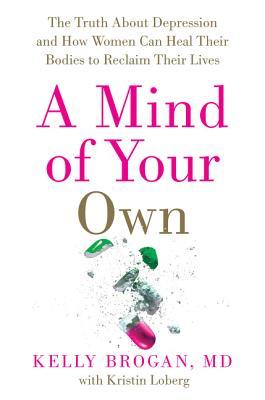
A Mind of Your Own: The Truth About Depression and How Women Can Heal Their Bodies to Reclaim Their Lives by Kelly Brogan, MD. Harper Wave| March 2016| 352 pages | $26.99| ISBN: 9780062405579
RATING: ****/5*
“We are engaged in lifestyles that are not compatible with what our genome has evolved over millions of years to expect. We eat a poor diet, harbor too much stress, lack sufficient physical movement, deprive ourselves of natural sunlight, expose ourselves to environmental toxicants, and take too many pharmaceuticals.”
My psychiatrist at Mass General Hospital recommended this book. A colleague recommended it to her. At my last visit she still hadn’t read it so we couldn’t discuss it. However we have discussed the mind-body connection; that I do not want to be dependent on Klonipin or my current SSRI [I am tapering off Lexapro]; that I believe in homeopathic treatments and see an acupuncturist; that I do yoga and I am a vegan. Going into this book I felt I was doing lots of things right but I still am miserable and low functioning. I don’t take a lot of medications outside my daily psychiatric meds, vitamins and supplements. I listen to my body. I feel fairly connected. My psychiatrist said that there’s a disconnect between my level of education and my level of function. That’s not easy to hear. But I know that it’s likely the truth as I cannot find work and struggle to get paid for anything at which I feel I excel. Writing reviews for example.
This book isn’t without controversy. For one thing Kelly Brogan, MD is an anti-vaxxer. I’ve worked as a healthcare professional and get my flu shot every year and have done so for the past decade or longer. Dr. Brogan believes that mental illness is not a chemical imbalance but a symptom of imbalance in our body. It is NOT a disease. I only recently started thinking that mental illness was a disease and a disability because I attended DBSA Boston meetings and that’s what the majority of people at DBSA and NAMI believe. Many receive SSDI.
Dr. Brogan writes: “Depression is merely a symptom, a sign that something is off balance or ill in the body that needs to be remedied.” This is much more complicated to both comprehend and accept. For how many years have we been told that we have some sort of chemical imbalance in our brains and with the right medication we might be able to stabilize it? She adds: “[sic] there has never been a human study that successfully links low serotonin levels and depression. Imaging studies, blood and urine tests, post-mortem suicide assessments, and even animal research have never validated the link between neurotransmitter levels and depression. In other words, the serotonin theory of depression is a total myth that has been unjustly supported by the manipulation of data.”
She also states something that’s way easier to understand: “So many patients today who are being shepherded into the psychiatric medication mill are overdiagnosed, misdiagnosed, or mistreated.” If you are like me, you’ve been to quite a few psychiatrists who churn out the prescriptions – one pill to wake you up, one pill to make you sleep, one to calm you down. And for some people they can handle side-effects such as weight gain and cognitive impairment. Some even seem resigned that they will always have that extra weight because they will always be on medication. Then there are the psychiatrists who speak to you for two minutes and give you an out-of-left-field diagnosis. That’s their interpretation of the symptoms with which you present combined with your lifestyle. You could likely get a different diagnosis depending where you go and who you see. I speak from experience. Brogan explains that over time antidepressants lose their efficacy and can result in chronic and treatment-resistant depression. Instead of helping us, medications make us feel worse. Of course Big Pharma controls the medical industry. It’s all well and good to want to be treated holistically but few insurances cover that. A script for another drug? Absolutely. Transmagnetic Stimulation [TMS], acupuncture, light therapy and cranial stimulation? Not so fast. What’s in it for Big Pharma? How can pharmaceutical companies make money? That’s the bottom line.
What can you do? Dr. Brogan focuses on diet, exercise, sleep, eliminating environmental toxins and meditation. If you’ve read Moody Bitches by Julie Holland, M.D. and/or Your Health Destiny by Eva Selhub, M.D. [which I HIGHLY recommend] this is somewhat familiar territory. Everybody knows that we feel better after a great workout, a good night’s sleep or a big salad. Dr. Brogan believes that inflammation causes depression symptoms and to get rid of inflammation you should eliminate gluten, dairy, GMOs, artificial sugars, NSAIDs and antibiotics. She’s also not a fan of birth control, statins, acid-reflux medications, fluoride and vaccines. Take what you choose from this book. There are definitely some thoughtful and useful tips and explanations. Embracing the mind-body connection remains the best treatment. Of course when you’re completely unmotivated, anxiety-ridden or too tired to move it’s tough to hit the gym and make yourself a healthy meal.
In one chapter, Dr. Brogan explains the importance of quality food to fuel the body. She suggests not eating processed food and to eat whole foods. So consuming products with fewer ingredients and eating more produce, legumes and grains will make you feel much better. In another chapter Dr. Brogan explains the importance of meditation, sleep and exercise. On lack of sleep, she writes: “Otherwise balanced, rational women are rendered near psychotic by the trauma of insomnia and disrupted sleep cycles. Their bodies and minds have “forgotten” how to do it. It turns out that one of the many poorly elucidated lasting effects of antidepressants is their interference with normal sleep patterns.” There’s an entire chapter focused on detoxifying our environment. She discussed everything from tap water to cell phones to cleaning products to dust. Admittedly some of what she claims to do seems unrealistic for many. Who is dusting every single day or using a body brush four times a day (to stimulate the lymphatic system)? In the chapter on tests and supplements, Dr. Brogan suggests certain tests such as thyroid functioning, MTHFR (methylation), and various vitamin levels. To my psychiatrist’s credit [I switched to MGH Psychiatry for a reason], the phlebotomist withdrew about eight vials of blood so I could be tested for a bevy of things including MTHFR. As for supplements, Brogan writes: “Magnesium, zinc, iodine, and selenium are essential to the body’s functionality.” You can read details about these supplements as well as many others. And yes, that can get expensive and insurance does not yet cover supplements. In summation, much of your mental and physical health remains in your control. You need to ask questions, conduct research and remain vigilant. Listen to your body.
Before she received her MD from Weill Cornell Medical College, Dr. Kelly Brogan earned a B.S. in cognitive neuroscience at MIT. She’s board certified in psychiatry, psychosomatic medicine and integrative holistic medicine. This book contains a plentitude of valuable information which may or may not be successful for you and your mental illness. I take zinc, magnesium and a multi-vitamin but may consider adding other supplements. I also want to try to go gluten-free although I adore toast! Mental health might be that element I can control in order to realize my goals.
–review by Amy Steele
FTC Disclosure: I received this book for review from Harper Collins.

Share this:

book review: Rare Objects
Posted by Amy Steele in Books on May 31, 2016
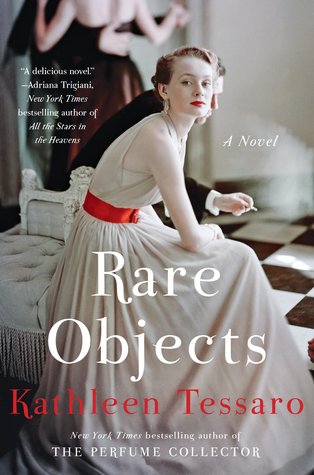
Rare Objects: A Novel by Kathleen Tessaro. Harper| April 2016| 378 pages | $25.99| ISBN: 978-0-06-235754-0
RATING: *****/5*
Set in 1932 Depression-era Boston, this novel wonderfully sets the scene for first generation Irish immigrant Maeve Fanning who recently moved back from New York after some struggles and setbacks. She’s living with her widowed mother, a rather strict Irish Catholic. The young woman straddles between her cloistered upbringing and her true desires. She wants to be independent and not married and pregnant like many of her peers. Here’s a scene in the small apartment: “Next to that, displayed on the dresser shelves, were my mother’s most precious possessions: a photograph of Pope Pius XL, a picture of Charles Stewart Parnell of the Irish Nationalist Party, and in the center of this unlikely partnership, a small wooden crucifix. Below, my framed diploma from the Katharine Gibbs Secretarial School took up the entire shelf.”
While in New York, Maeve struggled to find her place and find her identity. She couldn’t find a secretarial position as expected and worked in an unsavory club as a taxi dancer. She felt: “My life was full of cracks, ever-widening gaps between the person I wanted to be and the person I was. When I first came to this city, they used to be small enough to laugh off or ignore. But over the past year they’d grown wider, deeper. I’d fallen in one again last night.” While institutionalized she meets an intriguing, troubled young woman who seems out of place and also remarkably similar in attitude. Both women wanted freedom and the ability to shun convention.
Back in Boston, the fiery redhead dyes her hair blonde, calls herself May and lands an assistant position at an antiques shop that caters to Boston’s wealthy elite. She’s working for a retired anthropology professor and a mysterious English archeologist who travels most of the time but corresponds with the young assistant in enigmatic, clue-filled letters. These moments in the shop working with these two brilliant and strange men fill pages with adventure, treasures and wit. Add to that Maeve’s adventures with the aristocracy and it’s an unforgettable, enchanting read.
While delivering a purchase to a wealthy family, she meets lovely socialite Diana Van der Laar who she recognizes as the same young woman she met in the hospital. Diana takes an interest in Maeve and introduces her to high society as well as some dangerous situations. The two become rather inseparable at parties and events, Maeve blending in among the Boston Brahmin. In the beginning it’s glamorous fun. But soon: “The Diana I knew was a hard-drinking, rebellious prankster who had practically blackmailed me into being her friend. But to the outside world she was an elegant, accomplished society beauty with admirable philanthropic ambitions.” Dark secrets and betrayal extend beyond that idyllic façade. Maeve finds herself caught up in the deceit until she gains confidence to realize what appears perfect may not be the life that she wants. However it’s this symbiotic relationship that she finds difficult to relinquish: “There was sanity in our madness together that I couldn’t find with anyone else. So I ended up walking away. I needed her, apparently more than she needed me. But it was her refusal to even acknowledge me, her complete and utter disregard, that wounded me the most.”
Author Kathleen Tessaro adeptly describes both the immigrant North End and wealthy mansions with vivid detail. Superb writing and research merge to tell this wonderful story. Rare Objects is a page-turner about class, friendship and the things and people we value most.
–review by Amy Steele
FTC Disclosure: I received this book for review from Harper Collins.

purchase at Amazon: Rare Objects: A Novel

Share this:

book review: The Rainbow Comes and Goes
Posted by Amy Steele in Books on April 29, 2016
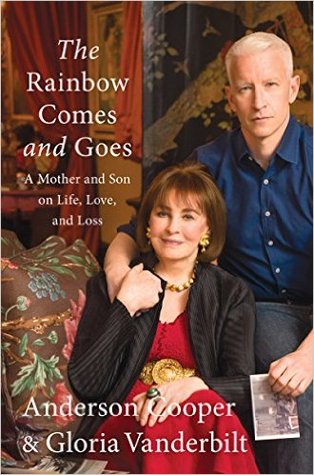
The Rainbow Comes and Goes: A Mother and Son on Life, Love, and Loss by Anderson Cooper and Gloria Vanderbilt. Harper| April 2016| 290 pages | $27.99| ISBN: 9780062454942
RATING: 3.5/5*
“I may look like my dad, but I am most definitely your son. We share the same drive and determination, the same restlessness and rage. It is good to know you’ve felt these things, too, and to see how they have both helped and hindered you.” –Anderson Cooper
If you’re reading this book to learn details about Anderson Cooper’s personal life, you will be disappointed. Cooper reveals nothing about his personal life. This epistolary memoir is an email exchange between a mother and her apparent favorite son. Both famous, both privileged, both introspective and thoughtful. Gloria Vanderbilt, now 92, loved a lot and also has a successful art and fashion career. She’s well-read—constantly quoting various authors to Anderson—and comfortable with herself and her choices and mistakes and life path.
Vanderbilt is the notorious “little girl lost.” You’ve heard of that haven’t you? Have you visited the Vanderbilt mansions in Newport, RI? I told someone I was reading this book and she didn’t know that Anderson Cooper’s mom is Gloria Vanderbilt. That’s not particularly surprising as Anderson maintains a high level of privacy. He built his own career as a television journalist. Yes, he graduated from Yale and grew up privileged in Manhattan but he’s clearly a hard worker and cares about journalism, exposing the truth and highlighting issues and telling stories that many might not focus upon.
Just because I didn’t adore this book, doesn’t mean I don’t adore Anderson Cooper. He’s a solid journalist and I listen to his show AC360 nearly every evening via podcast on TuneIn radio. In the introduction, Cooper writes: “Vanderbilt is a big name to carry, and I’ve always been glad I didn’t have to. I like being a Cooper. It’s less cumbersome, less likely to produce an awkward pause in the conversation when I’m introduced. Let’s face it, the name Vanderbilt has history, baggage.” Later in the book, Vanderbilt states: “As for you, Anderson, you have always had a fierce drive, a burning desire to make a name for yourself. For a long time I don’t think people even knew you were related to the Vanderbilt family.”
This exchange focuses mainly on Gloria Vanderbilt. Anderson Cooper wants to know some of the things that he never asked and now it might be appropriate as his mom is in her 90s. Vanderbilt discusses her childhood, revealing her difficult and tenuous relationship with her mother, who gave birth to her at 18-years-old. Vanderbilt lived with an aunt for the majority of her childhood and teenage years. But then there’s the bitter custody battle, perhaps for Vanderbilt’s money. Her mother spent much of her time traveling the globe and dating wealthy and powerful men. Like her mother, Vanderbilt married early and often and didn’t go to college.
She had four husbands [including her last, Anderson Cooper’s father Wyatt Cooper], four sons [she and Anderson do not discuss her two sons from her second marriage, except in passing] and many lovers including Frank Sinatra and Howard Hughes. She always seemed to have a man in her life and why not although I think she realizes that in her younger years it may have been better to develop independence and confidence without a man. Two months after Anderson’s father, Wyatt Cooper died, Vanderbilt was already dating ex-husband Sidney Lumet. Later in her life—I think she said at 54– she earned great success with those Gloria Vanderbilt jeans. She also held many art shows. Vanderbilt proves it’s never too late to start a career.
Apparently during the court battle there were allegations that Vanderbilt’s mom was a lesbian. Vanderbilt writes: “In 1934, being gay was considered evil. It was a crime. Gay people could be, and were, arrested, imprisoned, and institutionalized.” Bringing it back to himself as he often does in this book, Anderson responds: “When I told you I was gay, it must have brought up a lot of your feelings about your own mother. It makes sense to me now. I remember the day I finally decided to speak to you about it. I was really nervous.” Vanderbilt’s response: “I rejoice that you are gay! It is part of what makes you the person you are, and I am so glad that you have found someone who makes you happy. I wouldn’t want you any other way, even if that were possible, which it most certainly is not.”
Cooper’s definitely close with his mom. They’re extremely supportive of one another. It’s a mutual admiration society! But shouldn’t mothers and children be like this? I wouldn’t know. I’ve never had a close relationship with a parent featuring unconditional love and acceptance as Cooper and Vanderbilt. They convey admiration, empathy and respect of each other. Sometimes it seems too much. Too cloying. Too much applauding.
Cooper writes: “What is interesting to me is that you have always been able to keep going forward and at the same time have remained vulnerable. I worry that I have shut myself off to feeling, numbed myself so that I am not weighted down.” Vanderbilt responds: “You are a storyteller, and though you may wish at times that you didn’t feel pain, the fact that you continually put yourself in situations where you will, and where you can help others feel as well, speaks volumes about who and what you really are.”
Throughout the exchange, Cooper expresses empathy for his mom and her difficult childhood and poor relationship with her mother. Vanderbilt applauds Cooper. She tells him how much she admires him and loves him and thinks that he’s wonderful in so many ways. Sometimes it seems that they are quite self-centered—bringing each topic back to themselves– but this is their conversation which reveals their feelings and thoughts about past and present.
They’re quite different but also have many commonalities—particularly Carter Cooper’s suicide about 20 years ago. Also there’s money. Vanderbilt writes: “I wish I had known that the greatest gift of money is the independence it can give you. If you are lucky enough to have money, learn to hold on to it, but don’t be a miser, because it will shrivel your insides and start showing on your face in ways that will startle you.” Cooper says: “How many children of wealthy or accomplished parents have gone on to make their own mark?” Cooper apparently doesn’t have a trust fund and won’t inherit money from his mother. Both also feel they possess “the demon of rage.” Cooper says he’s fueled by rage. Vanderbilt states: “At best, I no longer agonize intensely as I did over my failings or the failing of others. I accept them. At worst, I have to admit that somewhere within still lurks a demon of rage. Age makes it impossible to put right the things that went wrong. There is little time left.”
The book has its moments. It is obvious that Cooper and Vanderbilt maintain a wonderful relationship. Take from it what you will. Every reader will find something in it that appeals to her. I’m surprised proceeds do not go to charity. At least partial proceeds. Neither needs the money.
–review by Amy Steele
FTC Disclosure: I received this book for review from Harper.
purchase at Amazon: The Rainbow Comes and Goes: A Mother and Son On Life, Love, and Loss

Share this:

book review: The Wander Society
Posted by Amy Steele in Books on April 9, 2016
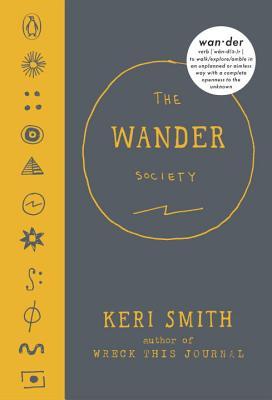
The Wander Society by Keri Smith. Penguin Books| March 29, 2016| 176 pages | $20.00| ISBN: 9780143108368
RATING: ****/5*
A beautiful looking book that explains a secretive society designed to allow a person to get in touch with one’s thoughts, one’s soul and nature. By now everyone knows that meditation, yoga and mindfulness help us pursue calmness and productivity. When author Keri Smith found an old copy of Walt Whitman’s Leaves of Grass, she stumbled upon the Wander Society. The members remain anonymous. Author Keri Smith explains: “While we cannot say for sure exactly who the Wander Society is, I believe its members exist to aid us in our quest to discover our own deepest soul life, to help us move to a higher plane of consciousness. That is the theme that seems to repeat itself again and again in its literature. Smith compiled this book after reading and researching any existing literature she could find associated with the Wander Society.
From an introductory pamphlet: “The path of the wanderer is an experiment with the unknown. To be idle, to play, to daydream.”
Included in this brief book: The Nature of Wandering–includes definition; the philosophy; the importance of “randomness” and how to find fellow wanderers; The Wander Society’s Tactical Guide—includes essentials; time; how to be invisible; wandering meditation; Wandering Initiation– includes setting out; creating a uniform; how to invoke an inner wanderer; Assignments/Research/ Field Work—there’s a ton in this section such as documentation; low wandering; sound tracking; leaving symbols; wandering by bicycle; library wandering; random painting; How-To Section—carving a wandering stick; making a wander belt pouch; making a wander notebook. In the end she includes Wander Society Lexicon; Leave Behind Quotes; Excerpt from Leaves of Grass; the Wanderer’s Creed and Wander Symbol’s Key.
Whether you decide to take up wandering every day or once a month, this book will certainly encourage you to try it. The beautiful typeset, photos and organization of the book create an appealing guide. It’s also the perfect size and weight to take along as a reference and inspiration during your wandering. Smith writes: “We need more rambling, daydreaming, thinking, perusing, being, looking, existing, allowing, ambling, opening, listening, because it teaches us what we are capable of. The nomadic tendency of wandering allows us to take pause, to consider what is really necessary, what is important for living well.” Wandering is a bit aimless but it’s also a way to think and observe. It’s a way to break our reliance on technology and take moments to savor the world around us. She adds: “The wanderer becomes one with himself or herself and the universe. We connect with the energy of all living things. We live according to our inner nature.” Another beautiful concept behind wandering: “When we enter into the wandering mindset, which can take a while to kick in, we actually change into our true self, not the person we are trying to be for society.”
In this book you will discover that wandering incites creativity. Smith writes: “qualities of great wanderers: “curious, inquisitive, nonconformist, rebellious, daring, revolutionary, inventive, visionary, solitary, self-sufficient.” That sounds ideal. Many of us—the writers, the artists, the radicals, the free-spirits—desire to be seen as change-makers, running against the grain, anti-societal expectations and precepts. Some well-known wanderers include: Walt Whitman; William Wordsworth; Charlotte Smith [an English Romantic poet and novelist]; Charles Baudelaire; Henry David Thoreau; Aristotle; Thich Nhat Hanh; Oscar Wilde; Rebecca Solnit and Virginia Woolf. So add wandering to your list which should include yoga, mindfulness [read the chapter on Wandering Meditation if you aren’t familiar with mindfulness because there’s such a thing as mindful walking] and meditation. So pack a snack, a notebook, a camera and a bottle of water and head out there to commune with the earth, discover something fresh. Wandering inside in libraries or old bookstores works too.
–review by Amy Steele
FTC Disclosure: I received this book for review from Penguin Books.
purchase at Amazon: The Wander Society

Share this:

book review: Willful Disregard
Posted by Amy Steele in Books on February 5, 2016
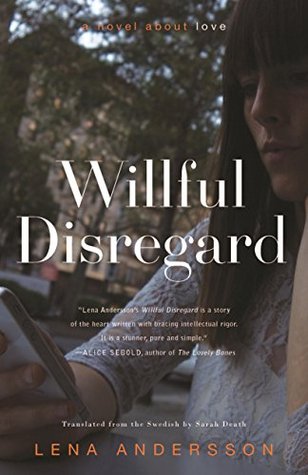
Willful Disregard by Lena Andersson. Other Press| February 2016| 196 pages | $15.95| ISBN: 978-1-59051-761-1
RATING: ****/5*
“Since realizing at the age of eighteen that life ultimately consisted of dispelling melancholy, and discovering language and ideas all by herself, Ester Nilsson had not felt any sense of unhappiness with life, nor even any normal, everyday depression.”
Another wonderful, challenging novel that’s difficult to adequately describe. This witty, novel delves into a careful examination of Esther Nilsson after she meets artist Hugo Rask. Quite the intellectual, existential read about unrequited love. It should be quite relatable to many readers. We envision certain situations in our minds. We misinterpret signals. In this modern age everything and anything remains open to interpretation. The course of love doesn’t travel a straight path. Swedish Author and journalist Lena Andersson won the 2014 August Prize for Willful Disregard, her ninth novel.
Ester is quite a meticulous academic while Hugo Rask is a laid-back artist and long-standing bachelor who surrounds himself with young admirers. Of Ester, Andersson writes: “She would rather endure torment than tedium, would rather be alone than in a group of people making small talk. Not because she disliked the small-talkers, but because they absorbed too much energy. Small talk drained her.” When Ester lectures on Hugo, they get together a few times to talk and that progresses into a physical relationship. Ester latches on to this more than Hugo. She doesn’t embark on sexual dalliances lightly. Now she’s questioning the minutiae of their connection. Are they dating? Does he care for her? Should she make any assumptions about anything?
An early indication that it was purely a sexual tryst: “Hugo never followed up anything Ester said. Ester always followed up what Hugo said. Neither of them was really interested in her but they were both interested in him.” At another times there’s this: “They asked each other what they had planned for the day, in the way you do when you don’t belong together even though you are sleeping with each other, that is, when one party has decided how things are to be on that score but not said so openly, believing it is meant to be inferred.” Also this: “But why did he want to be physically intimate with her if he did not want to be close? And why those long, intense conversations over the proceeding months?”
I found myself marking many sections due to the sparse impressive phrasing and strong meditative nature. It’s fascinating to follow how Ester navigates her relationship with Hugo as well with her disposition and desires. A thoughtful novel about love’s consequences and perceptions.
–review by Amy Steele
FTC Disclosure: I received this book for review from Other Press.
purchase at Amazon: Willful Disregard: A Novel About Love

Share this:

book review: All Days are Night
Posted by Amy Steele in Books on November 17, 2014
<em>All Days are Night</em> by Peter Stamm. Publisher: Other Press [November 2014]. Fiction. Hardcover. 192 pages.
A popular television reporter, Gillian, wakes up in the hospital to a disfigured face and a dead husband. Matthias, her husband, drove the car drunk, hit a deer and caused the couple to crash. She lost her beautiful visage and through numerous surgeries she’ll get a face back that was never hers. “It’s relatively straightforward to put an ear back, said the doctor, but a nose has a great many delicate blood vessels. We are going to have to build you a new one,” the doctor, hand mirror in his grip tells Gillian. “It doesn’t look very pretty at the moment, he said, but I still think it’s a good idea for you to take a look at it.”
She’s lost her identity. We’re all completely connected to our faces and bodies no matter what we think or desire. It’s a visual world. For some more than others. Gillian must deal with this loss and reconcile with whatever the surgeons reconstruct. Even her parents can barely deal with the new reality. Her mother can’t even look at her. Reminds me of the facial transplants completed at Brigham and Women’s Hospital. Final result: not exactly you and not exactly the donor.
“Her life before the accident had been one long performance. Her job, the studio, the designer clothes, the trips to cities, the meals in good restaurants, the visits to her parents and Matthias’s mother. It must have been a lie if it was so easy to destroy with a moment’s inattention, a false move. The accident was bound to happen sooner or later, whether in the form of a sudden catastrophe or a gradual unraveling, it was coming.”
Not only does she have to deal with reconstructive surgeries but career loss. To rebuild, Gillian escapes both the city and the tragedy. She heads to her parents’ isolated vacation home in the mountains. Gillian encounters an artist, Hubert, from her past that may or may not feature into her future. The fight between Gillian and Matthias occurred because Matthias found naked photos of Gillian that Hubert— an interview subject– took. Matthias drank too much at a party the couple attended and despite their friends’ concerns he insisted on driving. German author Peter Stamm revisits the encounters between Gillian and Hubert that caused tension between Gillian and her late husband.
As a cultural reporter, Gillian dipped into the arts and music scenes. An intriguing world combined with an electrifying profession. Hubert is a fame-fueled artist. Neither Gillian nor Hubert is terribly sympathetic. However they are both relatable and intriguing. Losing one’s looks, one’s face, one’s identity in that manner. A ghastly, unimaginable thought. What would you do? How would you cope?
The novel beautifully traverses past and present. Stamm writes in an effectively laconic and melancholy style. He’s exploring appearances from various angles. It’s a gripping read about art and connection.
RATING: *****/5
–review by Amy Steele
<em>FTC Disclosure: I received this book for review from Other Press.</em>

purchase at Amazon: All Days Are Night

Share this:

book review: Fly Away Home
Posted by Amy Steele in Books on July 6, 2010

Title: Fly Away Home
Author: Jennifer Weiner
ISBN: 978-0743294270
Hardcover: 416 pages
Publisher: Atria (July 13, 2010)
Category: women’s fiction
Review source: publisher
Rating: 3/5
Fly Away Home by NYT’s best-selling author Jennifer Weiner revolves around the family patriarch, Senator Richard Woodruff, who has an affair with a younger staff member. The cheating Senator story has been told so many times recently in real life. His wife, Sylvie, after standing with him at the press conference where he speaks about his infidelity, leaves him but doesn’t divorce him. For once, I’d like the woman not to stand by her man. Or how about a story where the Senator cheats on HER HUSBAND. Sylvie and Richard have two adult daughters: Lizzie, a recovering drug addict and Diana, the seemingly perfect daughter, an emergency department doctor living in Philadelphia, married with one son. Diana’s having an affair with a younger guy, a resident at the hospital. He’s not that much younger but that’s irrelevant. I just couldn’t get past the episodes of unsafe sex. Yes, that’s right. No protection and she considers herself a responsible doctor and mother? Yikes! I have no problem with the affair as I know that some marriages grow stale or routine over time. I do have a problem, a gargantuan problem, with unsafe sex. When Lizzie gets pregnant from the one time she has sex with a guy she’s seeing, I almost stopped reading completely.
Except in all the examples she could think of, it was always the male docs who treated the hospital as their personal harem, never the ladies.
Fly Away Home gets told from the point of view of the two daughters, Diana and Lizzie, and their mother, Sylvie. Jennifer Weiner is a solid writer for the women’s fiction genre and I so wanted to be engulfed in this book. Unfortunately, I found all the characters to be selfish. Well, that’s not completely true. I really liked Lizzie until she got pregnant. [Oh, and the guy she’s dating, Jeff, says: “Is it safe?” before sex.] I never became invested into their futures or how they’d fix mistakes or make changes to their messed up lives. Can anyone ever write about condoms or emergency contraception? It’s no longer such a taboo subject. Or is it? I suppose many writers just don’t want to alienate their audiences in some way. Weiner has alienated me a bit. And I’ve been sour on women’s fiction/ chick lit for some time.
Buy from Amazon: Fly Away Home: A Novel

Share this:

book review: The Girl Who Fell from the Sky
Posted by Amy Steele in Books on March 17, 2010

Title: The Girl Who Fell From the Sky
Author: Heidi W. Durrow
ISBN: 978-1565126800
Pages: 256
Publisher: Algonquin Books; 1 edition (February 16, 2010)
Category: literary/contemporary fiction
Review source: publisher
Rating: A
I am light skinned-ed. That’s what the other kids say. And I talk white. I think new things when they say this. There are a lot of important things I didn’t know about. I think Mor didn’t know either. They tell me it is bad to have ashy knees. They say stay out of the rain so my hair doesn’t go back. They say white people don’t use washrags, and I realize now, at Grandma’s, I do. They have a language I don’t know but I understand. I learn that black people don’t have blue eyes. I learn that I am black. I have blue eyes. I put all these new fact into the new girl.
The Girl Who Fell from the Sky is a provocative and creative coming-of-age in the 1980s story. Blue-eyed, mocha-skinned Rachel is the daughter of a black GI-father and a Danish mother. The sole survivor of a Chicago rooftop tragedy, the 12-year-old ends up at her boozing and opinionated grandmother’s house in Portland, Ore. Rachel spent most of her early years in Europe where she felt very comfortable in her skin and her mother wasn’t eyed strangely for toting around three children with skin shades darker than her own. Now back stateside, she’s struggling with her identity. A bookish girl, Rachel reads voraciously and favors history. Rachel is not easily labeled and that confuses many of her peers. Other black girls pick on her because of her eyes, light skin, and manner of speaking. Boys cannot figure out her exotic looks and demeanor.
Author Heidi Durrow spent years writing The Girl Who Fell from the Sky based on some of her own experiences. The novel provides further introspection. People still have issues with educated black people sounding “too white” or acting “better” than other black people or “selling out.” If you watch Oprah, she talks different ways depending on her audience and guests. Look at the critique that President Obama sometimes receives. And of course there was the entire questioning his race thing. White mother/ black father. What is so confusing? Isn’t America a big Melting Pot? Durrow crafts a beautiful story delving into a teenage girl’s psyche. Rachel overcomes past tragedy and current conflict as she becomes comfortable being Rachel. A unique individual. Using mysterious elements and a measured reveal, The Girl Who Fell from the Sky leaves the reader with many questions to ponder and is a must-read.
The Girl Who Fell from the Sky was a February Indie Next Pick.
shop Amazon:
The Girl Who Fell from the Sky

Share this:

About Me

covering mostly music and books. focus on alternative/indie and women in music, literature and the arts. feminist. vegan. mostly alternative, a bit bohemian. Masters in journalism from Boston University. BA from Simmons College.



Entertainment Realm by Amy Steele is licensed under a Creative Commons Attribution-Noncommercial-No Derivative Works 3.0 United States License.
Based on a work at entertainmentrealm.comCopyright © 2009. All writing, unless otherwise noted, by Amy Steele.
 ENTERTAINMENT REALM
You must be logged in to post a comment.