Archive for March, 2022
book review: In the Margins
Posted by Amy Steele in Books on March 20, 2022
In the Margins: On the Pleasures of Reading and Writing by Elena Ferrante
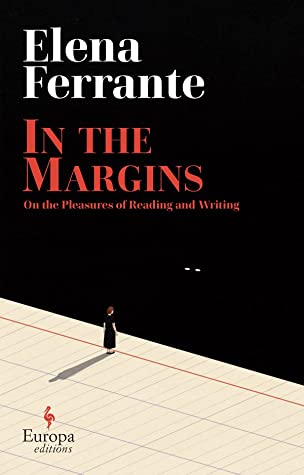
Europa Editions | $20.00 | Hardback | 9781609457372 | 176 pages | March 15, 2022
If you are a fan of Elena Ferrante, this is the book for you. If you’re wondering about the Ferrante hype, this is also the book for you. In the Margins originated as a series of lectures Ferrante gave at the University of Bologna. She discusses her work as a writer, including her technique, her influences and her struggles. Writers will be inspired by these essays. Writing is hard work, it can be frustrating but it’s worth the struggles in the end. Writing has an inherent power to connect, to educate, to comfort. You’ll want to spend time absorbing these essays.
I might be the only reader who hasn’t yet read all of the “Neapolitan novels.” I liked My Brilliant Friend but wasn’t blown away at the time. I do want to circle back to the others. I have become a fan through her other works. I quite liked The Lost Daughter. It’s a dark, honest and thoughtful novel about the challenges of being a mother. In anticipation of this essay collection, I recently read Incidental Inventions, essays Elena Ferrante wrote as a columnist for The Guardian. The topics covered include feminism, friendship, motherhood, writing, insomnia, addictions, nationalism, death and the recent film adaptation of The Lost Daughter—“I’m attached to that book in a particular way. I know that, with it, I ventured into dangerous waters without a life preserver.”
Like many successful writers, Ferrante is an avid reader and she started writing at a young age. She amasses journals filled with her stories and thoughts. Discussing her youth, she said: “I read a lot, but what I liked was almost never written by women. It seemed to me that the voice of men came from the pages and that voice preoccupied me, I tried in every way to imitate it.” She discusses the writing of Emily Dickinson, Virginia Woolf, Gertrude Stein and Dante, among others.
In her writing, Ferrante doesn’t hesitate to show the underbelly of humanity, the darkness. That makes her writing so strong and appealing. She explains: “Anyone who has literary ambitions knows that the motivations, both great and small, that impel the hand to write come from “real life”: the yearning to describe the pain of love, the pain of living, the anguish of death; the need to straighten the world that is all crooked; the search for a new morality that will reshape us; the urgency to give voice to the humble, to strip away power and its atrocities; the need to prophesy disasters but also to design happy worlds to come from there.” She said: “Beautiful writing becomes beautiful when it loses its harmony and has the desperate power of the ugly. And characters? I feel they are false when they exhibit clear coherence and I become passionate about them and do the opposite.”
Thank you to Europa for sending a copy.
Share this:

book review: Policing the City
Posted by Amy Steele in Books on March 2, 2022
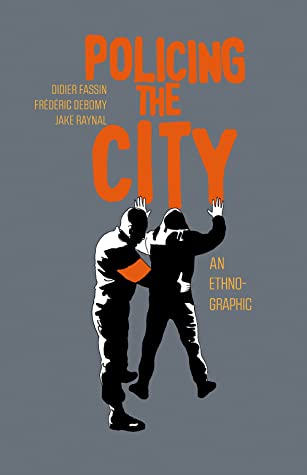
Policing the City by Didier Fassin, Frederic Dubomy, Jake Raynal
Other Press, March 1, 2022. 112 p.
Academic reports can be dry and difficult to absorb by those who aren’t in academia. Adapted from the essay ‘Enforcing Order,’ this ethnographic presents information in a thoughtful, accessible and creative format. It’s a fascinating exploration of law and order.
What is ethnography? Ethnography is a three-pronged social science practice. First, it involves sharing the everyday lives of those people studied over a long period of time. Second, the ethnographer establishes relationships and gradually makes discoveries, interfering as little as possible in the outcomes. Finally, it’s a writing practice that may take the form of articles , books, films, photographs to communicate their findings.
Anthropologist and sociologist Didier Fassin spent 15 months in the mid-2000s observing an anti-crime squad in one of the largest precincts in the Paris region. The French people face many of the same challenges as those in the United States, particularly racism and police brutality against immigrants and minorities. Fassin wanted to understand the violence in these working-class, largely immigrant suburbs—“But more, perhaps, than the number of deaths, it is the police’s daily harassment of low-income groups and racial minorities and hence the experience of humiliation, discrimination, and violence, that leave the deepest marks in these communities.”
Not only an academic, Fassin had first-hand experience as a resident of this urban community. His son was targeted by the police. In Policing the City, we see everyday routine and rituals and how police departments sustain prejudices and systemic violence against these communities. Fassin found that the police believe that judges can be too lenient and on-street punishment compensates for that. Police officers operate like vigilantes. Eight out of 10 officers were from rural areas or small towns with little experience in urban areas, leading to prejudices and leads to tensions and clashes between the police and residents of housing projects. He also observed that police have been given a lot of power and autonomy. This development led to more anti-crime squads throughout France. There needs to be greater diversity in police recruitment. In the UK, unarmed beat officers become integrated into the community. In the United States, an armed officer patrolling in a car with a limited relationship with the public is the norm. That’s the established model most everywhere worldwide.
Share this:

-
You are currently browsing the archives for March, 2022
About Me

covering mostly music and books. focus on alternative/indie and women in music, literature and the arts. feminist. vegan. mostly alternative, a bit bohemian. Masters in journalism from Boston University. BA from Simmons College.



Entertainment Realm by Amy Steele is licensed under a Creative Commons Attribution-Noncommercial-No Derivative Works 3.0 United States License.
Based on a work at entertainmentrealm.comCopyright © 2009. All writing, unless otherwise noted, by Amy Steele.
 ENTERTAINMENT REALM
You must be logged in to post a comment.