Archive for June, 2010
book review: The Particular Sadness of Lemon Cake
Posted by Amy Steele in Books on June 28, 2010
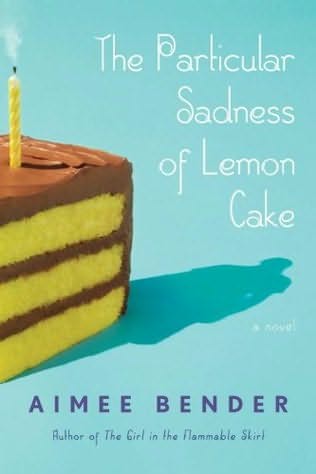
Title: The Particular Sadness of Lemon Cake
Author: Aimee Bender
ISBN: 978-0385501125
Hardcover: 304 pages
Publisher: Doubleday; 1 edition (June 1, 2010)
Category: modern fiction
Review source: publisher
Rating: A
The Particular Sadness of Lemon Cake stands out from other novels with its delightful and richly woven central character Rose. In tasting any homemade food, she has the innate and unusual ability to discover the feelings and secrets of the person who prepared it. When she’s nine, her mom serves her lemon cake and it’s quite upsetting for the young girl. But soon she grows into her special gift. She finds ways to embrace it or avoid it. Rose’s gift and its impact on her life– both positive and negative– slowly unfolds in a quiet yet riveting fashion that overflows with emotion. Rose’s special gift changes her relationships with her mother, father, unusual brother [who also has a strange secret], as well her societal interactions. Aimee Bender writes exquisitely. The fairy-tale magic realism propelling The Particular Sadness of Lemon Cake is charming and irresistible.
Buy at Amazon: The Particular Sadness of Lemon Cake: A Novel

Share this:

book review: In Our Control
Posted by Amy Steele in Books on June 26, 2010

Title: In Our Control: The Complete Guide to Contraceptive Choices for Women
Author: Laura Eldridge
ISBN: 978-1583229071
Paperback: 369 pages
Publisher: Seven Stories Press (June 1, 2010)
Category: women’s health
Review source: publisher
Rating: 5/5
A decade ago, I had an exploratory laparoscopy and asked my gynecologist if she would complete a tubal ligation as well. She insisted that I wait a few years to think it over. I’ve always known I do not want children. I’ve never heard a biological clock ticking. When I saw a 29-year-old guy interviewed on The Today Show because he had elected to get a vasectomy, I fumed. Are all women supposed to WANT to give birth or expected to desire children? What could possibly be the reason why I was denied tubal ligation at 29 yet a guy could get a vasectomy? Our sexist society.
I am such an adamant safe sex advocate that I carry my own condoms with me. Two years ago, another gynecologist at Brigham and Women’s Hospital suggested that I consider getting an IUD inserted for birth control. I hadn’t heard much about IUDs and now I’m considering getting one. In Our Control: The Complete Guide to Contraceptive Choices for Women by women’s health writer Laura Eldridge provided me with detailed and enlightening information about the IUD that I didn’t know. Eldridge covers the Pill, IUDs, Plan B [the morning after pill], HPV vaccinations and more. Women’s health– particularly women’s sexuality and contraception– is rarely addressed to the extent it should be.
Putting women in control of reproduction means addressing these social issues. Building reproductive freedom, including the ability to make contraceptive decisions, means working to give women—not the many cultural forces and people in positions of power around them—the ultimate right to make individual choices about pregnancy.
In Our Control doesn’t read like a scientific article but a wise and thoroughly researched expose on all aspects of contraception. Eldridge writes in a practical, often conversational format which should appeal to readers at all interest levels. This fascinating book presents women with the information they need to consider the appropriate contraception for their bodies. Every woman is different and every form of contraception isn’t the right one for every woman. Eldridge delves into the pros and cons, the history, and some future thoughts and goals of the medical community, the Big Pharmas and government agencies. In Our Control should be kept on one’s bookshelf for reference next to Our Bodies, Ourselves and FLOW.
Share this:

MUSIC: some songs to live by part I
Posted by Amy Steele in Music on June 26, 2010
Death Cab for Cutie, I Will Follow You Into the Dark
Coldplay, Fix You
The Charlatans, I Never Want an Easy Life
Cake, Never There
Lush, Hypocrite
Morrissey/ The Smiths, Paint a Vulgar Picture
The Clash, Train in Vain
Dido, Life for Rent
The Verve, Bittersweet Symphony
Snow Patrol, You’re all I Have
Share this:

CELEBS: That f-ing biological clock
Posted by Amy Steele in Film on June 23, 2010
Can we PLEASE leave Renee Zellweger alone?
Here’s US Weekly pitting the two women against each other in their “quest” for Bradley Cooper:
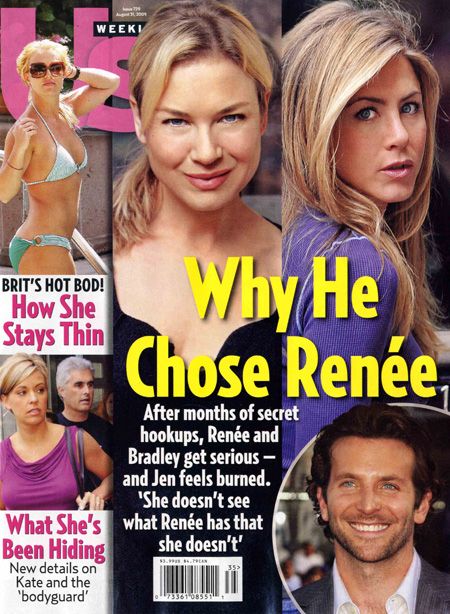
I realize I’m writing about it hear but no publicists will even deal with my site because I don’t get enough readers and apparently I’m not a very good critic/ writer.
Showbiz Spy announces engagement of Renee Zellweger and Bradley Cooper [both have had very brief marriages to Kenny Chesney and Jennifer Esposito respectively].

Showbiz Spy says:
Renee knows her biological clock is ticking and she’s desperate to settle down and have a family. She has told Bradley in no uncertain terms that if he doesn’t agree to raise a child with her, she sees no future for them as a couple. Renee is even prepared to adopt if she isn’t able to get pregnant.

Why does anyone have to be married or get married to have a child [see Halle Berry, Madonna and Sandra Bullock]? I’m SO tired of the biological clock. I’ve NEVER heard it ticking and I’m 37 or so.

Also, Renee is an extremely talented actress and I’m tired of her being portrayed as desperate to marry and also people saying poor Renee– why is she single? why can’t she make any relationship work? People might be jealous of her dating record– Jim Carrey, Jack White, John Krasinski, Paul McCartney [oh and read this 2007 Daily Mail piece about a desperate Renee], MSNBC’s Dan Abrams etc.
Or perhaps, Renee just hasn’t found her match yet.
Share this:

STEELE INTERVIEWS: singer/songwriter Dot Allison
Posted by Amy Steele in Interview, Music on June 22, 2010
Born in 1969, Scottish singer/ songwriter Dot Allison began her music career by fronting the band One Dove in the early 1990s. Allison released her debut album, Afterglow, in 1999. In 2002 We Are Science got released.
In addition to solo ventures, Allison’s career has concentrated on collaborative efforts. She also has recently forayed into writing music for film. She contributed Colour Me to Forgetting Sarah Marshall and has worked on the soundtrack for Triangle.

Recently, I had the pleasure to interview the talented and enchanting Dot Allison.
Amy Steele [AS]: You’ve been a solo artist for a decade. What do you like best about working on your own?
Dot Allison [DA]: Not having to deal with band politics. Also I am quite shy in some ways and found it quite hard to be heard in some environments with certain big personalities so those were aspects of being in a band I don’t miss. But I do miss the ‘gang of pals’ thing.
AS:What do you find to be your greatest challenges in writing music?
DA: Self discipline. I can really excel when I am very strict with myself but my default setting is one where I need to really focus on that side of things
AS: How do you like writing songs for others, such as Babyshambles.
How does it differ from your solo work?
DA: I was a very interesting experience and as Peter is a bit of a one-off, it is always a bit unpredictable but worth it. We really clicked as writers which was apparent early on. It is different from my solo work as it’s a democracy creatively and I am a different person to each person I write with as we all draw different strengths from each other.
AS: On Room 7 ½, you have collaborations with Paul Weller and Pete Doherty. Why did you choose to collaborate with them?
What do you feel these collaborations bring to the songs?
DA: Actually to be honest they both asked me, but as it felt like the sessions worked out I chose to use some of the resulting music.
I think Peter and I are a little juxtaposed in our vibes and sounds and for that reason among others the collaboration between us interests me. I always loved the jarring juxtaposition of Some Velvet Morning (Nancy N. Lees’s version) and felt it is a similar dynamic with the ‘boot on the other foot’ in that my character is pretty dark on that song.
I thought the richness and wealth of artistry with someone like Paul has in his musicality and his voice is almost another contrast all together where I sound more naive and fragile against his rich matured voice and presence. He is an amazing writer and owned his solo LPs so when he asked me to work with him it made creative sense to me immediately. I was honored.
AS: What was it like to co-produce this release with Rob Ellis?
DA: Great fun and very enlightening again. I was quite obsessed with some of Polly Harvey’s work with Rob and Mick Harvey and I was made up to be able to work with both Rob & Mick on this LP.
AS: How has your songwriting changed over the years?
DA: I think I am more disciplined around my lyricism which has evolved over time and am far more confident than I used to be too
AS: What do you like best about Room 7 ½?
DA: It’s an honest record that is not trying to follow trends I think.. It’s it’s own vibe perhaps?
AS: What was the genesis for “Cry,” “Fall to Me,” and “Love’s Got Me Crazy?” [three of my favorite songs on Room 7 ½]
DA: Oh thank you. Cry was an electronic track that I fell for the acoustic version of and then once Rob and Mick got involved it sort of became a different creature again.
Love’s Got Me Crazy was a song Paul asked me to co write on and I asked if I could put it on my LP!
Fall To Me was a piano track that everyone loved and Rob treated. I wanted to write something filmic and emotive and that was the result.
AS: How do you remain inspired to write and record music?
DA: Just being alive maybe. Life always throws things at us and as long as it does that I think my way of processing some of it is or will be through creativity. I used to write poems when I felt low and creating something was like a cure. It turned apparent negatives into something positive and I think my music has a bit of that in it. But it’s really a celebration of life.
AS: The music industry is still quite male-dominated. What type of barriers have you had as a female artist?
DA: Lots probably, and mainly people’s unconscious stuff, it’s very hard to quantify! But as long as women are objectified in the media and in life, I think we face barriers men simply don’t to the same degree.
AS: You have such a lovely voice. What type of training have you had?
DA: Thanks again! Not much really. I went to voice lessons with Tona De Bret for a year or so on and off. She was famously sent Johnny Rotten as a pupil. But I just learned about exercises that take pressure off the throat and to warm up for sessions and try to create a bit of vocal ‘memory’ by singing regularly.
AS: When did you realize you could have a career as a singer/songwriter?
DA: In the second year of my Biochemistry degree!
AS: How do define a good song?
DA: One that moves me emotionally in some way.
AS: When do you know that you are finished with a song?
DA: Good question! That changes by the day. A song I thought was finished years ago I can now think needs lots done to it. I think working with a team is good to help you see the end point.
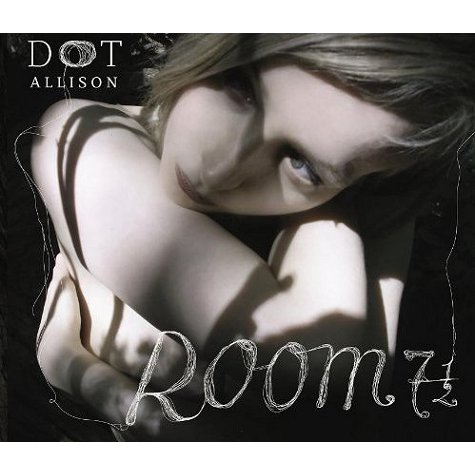
Dot Allison’s Room 7 1/2 will be released on June 21.
pre-order at Amazon: Room 7 1/2

Share this:

STEELE INTERVIEWS: chefs Benjamin Knack and Jason Santos [Hell’s Kitchen]
Posted by Amy Steele in Interview, TV on June 22, 2010

On Friday, I spoke with the two Hell’s Kitchen contestants from Boston– Executive Chef Jason Santos [Gargoyles on the Square] and Executive Chef Benjamin Knack [Sel de la Terre]. Both guys shared candid, refreshing thoughts on Hell’s Kitchen [and more]. And bonus for a reporter: both guys are verbose. Ben gets a few more bonus points because he described many vegetarian dishes for me that made my mouth water. I learned so much about the restaurant business, kitchens, staffing, cooking styles, flavors and of course being on Hell’s Kitchen.
Amy Steele [AS]: Why did you decide to take part in Hell’s Kitchen?
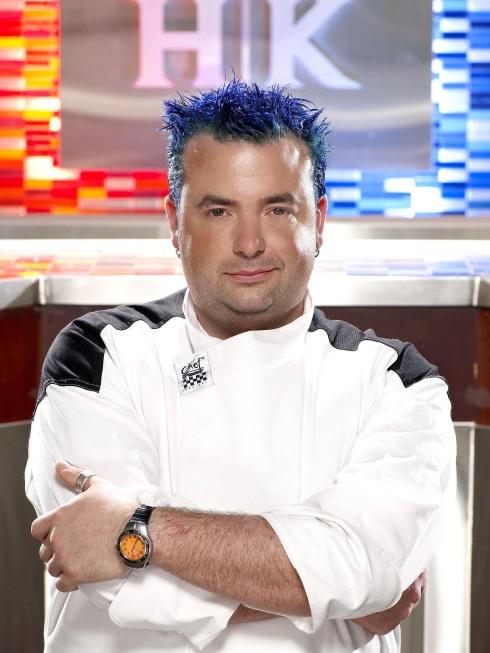
Chef Jason Santos
Jason Santos [JS]: I don’t really have a phenomenal answer except that I’ve always worked in small restaurants that don’t really have a lot of money for PR. So I figured if I could get on the show, I could get to that national level that I feel like I should be at. I also did it because I’ve admired Gordon Ramsay for a really long time. I was really psyched to work next to him. I got to cook with him every day.

Chef Benjamin Knack
Benjamin Knack [BK]: It started about five or six years ago. I’ve always been a big fan of Gordon Ramsay. I wanted to get the chance with Gordon. I worked in really physical kitchens with a bunch of French chefs and Italian chefs, who were very very physical — scream, yell, throw stuff, grab you, kind of push you around the kitchen. So when I heard about Hell’s Kitchen, I said “I can handle that as long as I don’t get kicked out of the kitchen.” I love Gordon Ramsay and I wanted the challenge of him trying to throw me out of the kitchen.

AS: What did you know about Gordon Ramsay before and what did you learn from him on the show?
JS: I have ten of his books. I feel that we have very similar personalities. The one thing I love about Chef Gordon Ramsay is that he is the most charismatic and witty person I have ever met. And I sort of pride myself on my wit. His standards are unbelievable. He’s got 14 Michelin stars. Just to be at that level. How do you even get to that level? I’ve always admired that about him. I love his personality on television. I know he can be abrasive but I love it.
BK: Gordon worked in restaurants that I wish I could’ve worked at, that are in books that I’ve read. When Gordon came out with his own restaurants it was about flavors, amazing sauces, amazing purees, perfect vegetables and things cooked perfectly. I’m a very technical chef. I don’t do things that are floating on your plate. I don’t have an apple that tastes like a chicken. I do basic French techniques and I think Gordon does a great job. He’s always been an idol of mine.
AS: What did you expect when you arrived on the show/ during the competition?
JS: Andy Husbands from Tremont 647 was on the show last year and I worked for him for seven years. We tried out together and we made the show different seasons. I told him I didn’t make the show because I didn’t want him to come back and tell me this is how it’s done. I wanted to go in with zero expectations. I didn’t want to know anything. If I prepare, I normally don’t do as well. It’s a TV show first and foremost. It’s about the editing. I never even cooked to make the show. There are eight million people watching each episode. You can only get edited to a certain point. It is what it is. I saw it as sort of a game.
BK: I want to be in the moment. So I decided not to watch the show, not to study for it, not to have a strategy going into it– go there, live the moment, experience it. If you live life like that, for the most part you usually win. You get the most out of it if you are living life and not going through the motions. My expectations of Hell’s Kitchen: I thought it would be like a regular kitchen, prep and cook and work all night and Gordon’s going to yell and scream at you. But it’s ‘tomorrow’s a challenge:’ get ready for egg cooking. I was in for a rude surprise for what it was like. I thought it would be more like cooking school or cooking camp. So my expectations were thrown out the window after the first few days. You are always in a loop. You never know what’s going on.
AS: How is it working with people from all different backgrounds? Or are you used to it having worked in the business so long?
JS: A little bit of both. You have some people who are really good cooks and some people who are really bad cooks and when you put in all these alphas and when they’re all competing for $250K, interesting things happen. When I hire people, I usually get to choose the level of culinary knowledge. So if I have room for someone more entry level and I can train them, that’s great. Or if I only want to hire someone with a lot of experience I can do that as well. Whereas in Hell’s Kitchen, you have some people who have never cooked on a line before. But that makes for good TV. If you bring together a bunch of people from different ethnic backgrounds, life experience backgrounds, culinary backgrounds and throw them together and say, “Go!,” it makes for great TV.
BK: Top top-end restaurants, they call it competitive kitchens. We want to be better than the kitchen next to us. Legal Seafoods just wants to make money. We want to cook for 300 people like we’re cooking for 120 people [the quality]. We have people in culinary school, people who’ve never cooked before and are in bands, people who work at Sel [de la Terre] during the day and Sonsie at night. We have people at all different levels and experience so it’s very realistic for me. I’m very used to it. We might be the same age but where I am in my life is my life. Where you are in your life is your life. My job as a chef is to make you as successful as possible and share all my knowledge. I like diversity. I grew up in Queens. And that’s all experience, monetary backgrounds and race. Everyone has their different tricks and you can really absorb that and grow together.
AS: What did you learn on the show?
JS: I learned a lot. The cool thing about Hell’s Kitchen is when you’re in the kitchen, you’re IN the kitchen. It was like a job. You’d wake up in the morning, go prep all day and do dinner service at night. My cooking style is not known for being simple. Hell’s Kitchen has really simple food: really fresh ingredients, just a few items per plate. That’s what I tell people: you have the Gordon side, which is extremely real and then you have the TV side. You cooked it good, you cooked it good. If he calls you out, he was right. I thought that was really cool. And just to cook next to him and watch him. He’s definitely a teacher. He’d show you how to do it his way.
BK: Gordon shares techniques: timing, communications, cooking. He’d pull me aside and say, “That looks great. But here’s a way to do it better.” That’s much better than him just saying something looks great. Gordon’s one of the best chefs in the world. When he works with you on something, that’s amazing. He’s sharing his knowledge. During the show he’s 100% genuine. He may scream and yell when something’s wrong and he’s really pissed. When he says something’s good, he really means it. When he shares something with you, he’s really open, really caring. He’s very passionate about the ingredients. You don’t see us break down the kitchen. You don’t see us prep. I prep really hard. I work very hard to get my station set up. A lot of places that aren’t like the kitchen ARE like the kitchen. When you lose a challenge, you do things that people do every day. Cleaning up the water—you can be there and bitch and moan or you can go with the attitude that you don’t do this every day and actually appreciate losing a challenge.
AS: What was the greatest challenge?
JS: Being away from everything. Full blown sequestering: no email, no phone, no magazines, no radio, no pens and papers. Nothing. We did a photo shoot the first day we were there and while we were waiting, I was flipping through a magazine and as a joke I ripped out a picture of Paris Hilton, smuggled it back to the dorm and put it on my nightstand. I woke up the next morning and it was gone. You go together and you leave together. So to be away for two months is challenging.
BK: Being without my family. I never spend a day away from my wife or my daughter. A lot of chefs work and then go away. Since my daughter was born, I’ve spent every day with her. It’s all about the family. We cook dinner together. Ella breads the fish, she mixes salads and she makes eggs for us. [note: Ella is two and favors using the blue heat-resistant spoon to do her cooking.] We do all the things that most people don’t appreciate. We do things together as a family and we appreciate everything we do. When I was away, I missed all those things. I’m not talking to my wife. I’m not seeing my daughter. The biggest challenge was getting over not being able to see them.
AS: Best part of HK?
JS: To win a reward. And you only see five minutes on television. The little breaks kept me sane. The first episode we did a helicopter ride. I’ve always wanted to go up in a helicopter and I got to do that—flying over L.A. sitting next to Gordon Ramsay was amazing.
BK: Working together with everybody. Being part of the production and not just being part of the show—interacting with the sous chefs, interacting with Gordon, interacting with production. Experiencing everything, not just the TV part. The whole is more important than the means. It was definitely life changing. Gordon puts his heart and effort into it.
AS: When I was talking to people via Twitter during the last episode, we wondered why more people didn’t know how to make risotto when it’s on the menu every year.
JS: There’s 563 ½ ways to make risotto. So you can practice all day long. I’ve been making risotto for 15 years and I’ve never made it the way Gordon makes it. Some people like risotto really thick. Some people like it really thin. You certainly can’t practice something you haven’t been shown how to do. We were given a recipe book and we had to remember 12 items for the menu—not only what they were but each individual ingredient to make each item. Basically it was, “Here’s a book and a photo, go make it.”
BK: It’s more complex than it looks on TV. Making risotto for Gordon Ramsay, a Michelin-rated chef is slightly different quality. Every chef has a different technique so it is different. When you work in someone else’s kitchen and they say the wall’s blue and it’s red, the wall is blue. It’s however that chef wants it. You learn that chef’s palate and technique as you work in that kitchen.
AS: How different is it to work when every move is scrutinized, names are called, and people are undermined?
JS: I can’t believe I’ve made it this far and haven’t gotten yelled at yet. [Hell’s Kitchen] is brigade style and very few kitchens still use that. Brigade style is that if you’re doing vegetables, you’re just doing vegetables. That’s all you cook all night long. So now you have to time the fish guy who serving it, with the meat guy . . . So whatever you’re doing that’s all you need to worry about.
AS: What was your signature dish?
JS: Grilled Hangar Steak, corn & queso fresco salad, black truffle demi-glace, nasturtiums [funky flower, very peppery, similar to arugula]
[note: nasturtiums were Isabella Stewart Gardner’s favorite flowers that she hung annually in the museum courtyard]
BK: Butter poached lobster with lobster agnolloti, English peas and truffle foam.
AS: How will you apply your Hell’s Kitchen exp to your career?
JS: It’s like anything. If I read a cookbook, I apply it to my cooking. Whatever we served in Hell’s Kitchen, I took some of the things I loved and put my own tweak on them.
BK: I keep things simpler. Gordon’s about simple, quality techniques. On set they call me Gordon Jr. because I always say hello to everyone and talk to everyone. Just continuing to push for perfection. And when times are tough, pushing my staff and pushing myself.
AS: Do you think you have to be omnivorous to be a good chef?
JS: Yeah, I don’t know. I’m sort of tough on vegetarians. I always have at least one plate that’s vegetarian that’s really creative. We put a lot of effort into it. Some restaurants just serve vegetables on a plate. The more restrictions you have, the less a chef can shine.
BK: No I don’t think so. For a good chef, you have to cook to your strengths. You have to find the right venue. I’m only a chef if I’m in the position as a chef. Otherwise I’m a cook. Before service, I walk the line and taste everything.
Hell’s Kitchen airs at 8pm Tuesdays on FOX.
Both chefs have Hell’s Kitchen viewing events at their respective restaurants every Tuesday to discuss the show and answer questions.
See websites for additional information.
Info on the chefs:
Chef Jason Santos
Executive Chef at Gargoyles on the Square in Somerville, Mass.
Facebook
Jason’s twitter
Chef Benjamin Knack
Executive Chef at Sel de la Terre, Longwharf, in Boston, Mass.
Facebook
Sel de la Terre twitter
Ben’s twitter
Share this:

book review: Bitch is the New Black
Posted by Amy Steele in Books on June 22, 2010

Title: Bitch is the New Black
Author: Helena Andrews
ISBN: 978-0061778827
Hardcover: 256 pages
Publisher: Harper; 1 edition (June 1, 2010)
Category: memoir
Review source: publisher
Rating: 4/5
I’m a bitch. I’m white. I’m a WASP from Boston. Mostly I’m jealous when I keep reading memoirs such as Bitch is the New Black— about the challenges of being a single professional [although many would think that’s a stretch for me as I’m not that successful]. Why haven’t I yet written a memoir about all the miserable men in my life? When I read a memoir such as Bitch is the New Black by Helena Andrews it motivates me to get writing. Oh and if you aren’t already jealous of Washington D.C.-based reporter/writer Helena Andrews, Bitch is the New Black has already been optioned by Grey’s Anatomy and Private Practice producer/writer Shondra Rhimes.
You certainly don’t have to be black to relate to this memoir. How ridiculous would that be? Helena writes about when the Congressional Black Caucus meets in D.C. [The CBC is to single-black-chick Washington as Fleet Week is to single-white-gal New York. Seamen? How ‘bout degreed men!]—to her lesbian mother—walking her “racist” dog through the sketchier areas of DC [The dregs of LeDroit Park hang around the busted-up concrete slabs that make for a sidewalk outside. I won’t assume these men push “product” for a living, but, well, they wear puffy black coats in summertime.]—how being an educated black woman can often be a huge roadblock to establishing a serious long-term relationship to a guy—why work can be more rewarding than dating—to her best friend’s decision to only date white men–and other much more observant and timeless topics.
I’d spent the last thirty days doing everything to prove myself worthy of calling this jackass my boyfriend. When Dex called me at 3:00 a.m. wanting to talk about nothing in particular [but really everything indefinable], I answered the phone [which had been waiting impatiently beneath my pillow]. When Dex wanted dinner, I cooked as if I hadn’t ordered the No. 17 from Sala Thai for the last six days in a row. When his number showed up on my BlackBerry in the middle of a Tuesday [ice cream at the Lincoln Memorial!], I slapped an end quote on the ass of another boring story and ran outside to meet him. I even had an “in case of Dex” bag under my desk at work [mascara, thongs, Burt’s Bees, invisible solid]. I washed his dishes when mine nurtured micro universes at home. I did his laundry while going pantyless by necessity. I gently lectured him on fiscal responsibility while waiting in line at ACE Check Cashing and Pay Day Loans.
All jealousies aside, Bitch is the New Black provides yet another stand-out memoir by a strong, opinionated, independent woman who has achieved monumental professional success but by society’s standards hasn’t yet hit her stride on the personal front. And does that matter at 30? Sure, even the most intelligent women resort to embarrassing ridiculous and oft-demeaning behavior around men. Try getting to 40 and realizing that BOTH one’s personal and professional lives are hot messes. Andrews’s writing is bright, refreshing and Bitch is the New Black is chocked full of entertaining anecdotes and vivid descriptions. Definitely add it to your reading list.
Share this:

STEELE INTERVIEWS: author Sloane Crosley
Posted by Amy Steele in Books, Interview on June 18, 2010
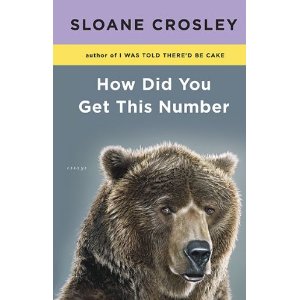
Title: How Did You Get This Number?
Author: Sloane Crosley
ISBN: 978-1594487590
Hardcover: 288 pages
Publisher: Riverhead Hardcover (June 15, 2010)
Category: personal essays
Review source: publisher
Rating: 5/5
How Did You Get This Number? is an often laugh-out-loud, witty and observant collection of essays.
Amy Steele [AS]: How did you start writing personal essays?
Sloane Crosley [SC]: I fell backwards into it, writing on occasion for The Village Voice when they’d let me. Then I started writing for other venues and then, really, for myself. That’s when I truly got comfortable enough to write what I wanted to write.
AS: What do you like best about this writing format?
SC: It forces you to find the artistic frame around every experience, no matter how common or how extraordinary.
AS: When did you decide to be writer?
SC: Have I? I think I just have the best relationship with the medium. I love it, I’m frustrated with it, I can express what I want to express best through it. But if I had to choose, I think I’d be a rock star with stellar stage banter.
AS: I would like to do this kind of writing but have no idea where to begin. How do you write/ what kind of schedule do you have?
SC: I don’t have a very rigid schedule. I think the beauty of writing essays is that there’s generally an end in sight. In How Did You Get This Number, the essays are longer and darker – and hopefully often funnier – than they were in I Was Told There’d Be Cake. So unless you have a book deadline for a whole string of them, you can always start one when you have time, get half way through, realize it’s not turning out how you’d like and toss it. That’s not a great feeling but it’s also not the same thing as scratching 200 pages of a novel.
AS: How many drafts do you write before the final version?
SC: It varies per essay but between two and five.
AS: When you write, how conscious are you about the amount of humor and amount of seriousness in each piece? In “Light Pollution,” you are able to point out some of the ridiculous aspects of Alaska while simultaneously having deference to its majestic nature.
SC: I think I write like my grandmother used to cook. When you’d ask her how much sugar or salt should be added to a dish, she’d often say “you know when your heart tells you.” That said, if she really took a wrong turn, she’d consult a recipe book. So I like to do whatever comes naturally, adding humor or pathos when it feels right. But if the rhythm is off when I edit or if it’s just not working, I will insert or remove jokes.
AS: In “If you Sprinkle,” you talk about silly pre-teen games like Girl Talk and then also the unrealistic influences for one’s early twenties. How does the media affect one’s expectations?
SC: Perhaps it’s that expectations and desires for how to be a woman or even just how to be a grownup seep in while we’re not looking. It becomes difficult to pinpoint how we came to want the things we do.
AS: You say you’d never be “asked back” to Paris in the essay “Le Paris!” Why do you feel that you don’t belong there?
SC: I manage to break their rules without even trying. Which is a shame.Because I have a profound affection for their macaroons.
AS: How do you remember things so well?
SC: I think most people have very good memories. It’s how they choose to use them. And it is a muscle that can be worked. Once you know you want to put down an experience in writing, you try to find every entry point back into that experience. If it’s worth writing about, you probably won’t get stumped.
AS: What is your worst New York apartment or roommate situation?
SC: I had a roommate I write about in the essay called “Take A Stab At It.” She borrowed my things without asking to a ridiculous degree and yet labeled her food. Mostly we just were very different people who didn’t get along. But she never sacrificed a chicken in my bedroom or anything like that. So I suppose I’ve had it pretty good.
AS: What is the greatest challenge in traveling alone especially when you went to Portugal?
SC: Creating your own schedule. It can be tough to have a traveling companion with a traveling style and set of priorities that differ from your own. But if you go it alone, you perversely miss that.
AS: How does working in publishing affect your writing and vice-versa?
SC: I am lucky in that I work with writers who are infinitely more talented and famous and usually both —so it can be intimidating. But it’s also very motivating to work with your heroes and get paid to do it.
AS: What do you like best about writing?
SC: You can read it more easily than you can read a block of cheese.
Bostonians — Sloane Crosley will be reading at Brookline Booksmith on Friday, July 25 at 7p.
TOUR DATES:
Friday, June 18
Los Angeles
Book Soup
8818 Sunset Blvd.
7 PM
Saturday, June 19
Bay Area
Rakestraw Books
Danville, CA
12 PM
Saturday, June 19
Bay Area
Book Passage
51 Tamal Vista Blvd
Corte Madera, CA
7 PM
Monday, June 21
Portland
Powells
1005 W. Burnside
7:30 PM
Tuesday, June 22
Seattle
Sorrento Hotel
900 Madison Street
(sponsored by Elliott Bay Book Co)
7 PM
Wednesday, June 23
Seattle
University Books
7 PM
Thursday, June 24
Denver
Tattered Cover – Colfax Store
2526 East Colfax Avenue
7:30 PM
Friday, June 25
Boston
Brookline Booksmith
279 Harvard Street
7 PM
Monday, June 28
New York City
McNally Jackson
50 Prince Street
7 PM
Monday, July 21
New York City
Bryant Park
“Writers on Writing” event with Larry Doyle, Josh Kilmer-Purcell and Simon Rich
Thursday, July 22
Philadelphia
Philadelphia Free Library
7:30 PM

Share this:

MUSIC: California Gurls by Katy Perry is SO lame
Posted by Amy Steele in Music on June 17, 2010
Not too long ago, I saw Katy Perry in concert– sassy and fun. I kind of put her in the same category as Britain’s Lily Allen but while Lily’s music is as buoyant, she puts more depth and thought into her lyrics. Perry is the 25-year-old singer who gained popularity for her song “I Kissed a Girl,” which angered Beth Ditto of The Gossip. Her last release called One of the Boys doesn’t exactly shout women power particularly the song “If You Can Afford Me,” although I used the song “Hot and Cold” as a ringtone for the last guy I dated who is a pathological liar and drunk.

So this latest video isn’t really a surprise: Perry and back-up dancers shimmying around in candy-themed bikini tops and Daisy Dukes, melting popsicles and other really silly sexual innuendos. Fiance Russell Brand must be her new influence in the blatant raunchy humor that is so inane.
From the song, we just get the impression that California “Gurls” are shallow, golddigging women who attract men with looks and sex but no intelligence or inner beauty.
That’s why I’m happy to be representing EAST COAST.
lyrics:
I know a place where the grass is really greener
Warm, wet and wild, there must be something in the water
Sipping gin and juice, laying underneath the palm trees
The boys break their necks trying to creep a little sneak peek
You could travel the world
But nothing comes close to the golden coast
Once you party with us, you’ll be falling in love
Oh, oh, oh, oh, oh, oh
[Chorus]
California girls, we’re unforgettable
Daisy Dukes, bikinis on top
Sun-kissed skin, so hot will melt your popsicle
Oh, oh, oh, oh, oh, oh
California girls, we’re undeniable
Fine, fresh, fierce, we got it on lock
West coast represent, now put your hands up
Oh, oh, oh, oh, oh, oh
Sex on a beach we get sand in our stilettos
We freak in my jeep, Snoop Doggy dog on the stereo
You could travel the world
But nothing comes close to the golden coast
Once you party with us, you’ll be falling in love
Oh, oh, oh, oh, oh, oh
(Chorus)
[Snoop Dogg]
Toned, tan, fit and ready
Turn it up cause its gettin’ heavy
Wild wild west coast
These are the girls I love the most
I mean the ones, I mean like she’s the one
Kiss her, touch her, squeeze her
The girls a freak, she drives a jeep
The men on the beach,
I’m okay, I won’t play, I love the bay
Just like I love LA
Venice Beach and Palm Springs
Summer time is everything
Come on boys, hanging out
All that ass hanging out
Bikinis, tankinis, martinis, no weenies
Just to get in betweeny
Katy my lady (yeah)
You looking here baby (uh huh)
I’m all up on you
Cause you representing California
(Chorus)
[Snoop Dogg]
California girls man
I wish they all could be California girls (x2)
There’s only a few children who do what we do
Read more: http://justjared.buzznet.com/2010/05/08/katy-perry-california-gurls-lyrics/#ixzz0r7GgseLk
Share this:

book review: The Three Weissmanns of Westport
Posted by Amy Steele in Books on June 16, 2010

Title: The Three Weissmans of Westport
Author: Cathleen Schine
ISBN: 978-0374299040
Hardcover: 304 pages
Publisher: Farrar, Straus and Giroux; 1 edition (February 2, 2010)
Category: modern fiction/ women’s fiction
Review source: publisher
Rating: 3.5/5
Looking for a refreshing non-vampire or zombies Jane Austen-inspired novel for this summer? The Three Weissmanns of Westport by Cathleen Schine should be the perfect warm weather read– whether at the beach or sipping iced coffee in air-conditioning. At nearly every turn you’ll recognize Schine’s modern take on Sense and Sensibility—from the patient semi-retired lawyer Roberts to the young actor Kit who takes up with older woman Miranda Weissmann.
When Betty Weissmann’s husband of 50 years decides to divorce her, he boots her out of their swanky Upper West Side abode at the request of the younger woman in his life. Betty retreats to a cousin’s cottage on the Gold Coast of Connecticut, specifically in Westport. Her two daughters, bold literary agent Miranda [Though she was acknowledged even by herself to be extraordinarily self-absorbed, no one ever accused Miranda Weissmann of being selfish.] and librarian Annie decide to lease out their Manhattan apartments to join her. And though there aren’t many details about Westport and I moved away at age eight when my parents divorced, I remember Compo beach quite well and it figures dominantly in the book. The Three Weissmanns of Westport proves to be a clever diversion.
The Three Weissmanns of Westport: A Novel

Share this:

-
You are currently browsing the archives for June, 2010
About Me

covering mostly music and books. focus on alternative/indie and women in music, literature and the arts. feminist. vegan. mostly alternative, a bit bohemian. Masters in journalism from Boston University. BA from Simmons College.



Entertainment Realm by Amy Steele is licensed under a Creative Commons Attribution-Noncommercial-No Derivative Works 3.0 United States License.
Based on a work at entertainmentrealm.comCopyright © 2009. All writing, unless otherwise noted, by Amy Steele.
 ENTERTAINMENT REALM
You must be logged in to post a comment.