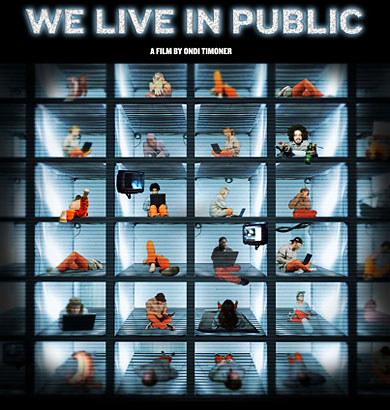
We Live in Public starts with a bang. The images and information hurdle at you just like on the Internet. It is fast-paced, frenetic and jumpy. This provides that fleeting feeling that one idea does not last very long as people lose interest very easily. Tastes change. Fads change. Markets change. Popularity rises and falls. Inexplicably so in many cases. As soon as one idea is popular (MySpace), then people have already moved on to the next great cool site (Facebook), and then to the newest and coolest (Twitter). But all these “cool” online sites are watching you in their own secret, unique ways which may be benign but may not be. At this time, we really do not know. We Live in Public provides us with a cautionary tale of what can happen when an individual loses himself in the public domain.
Directed by Ondi Timoner [Dig!], We Live in Public focuses on an egomaniacal, loner, geeky, dot.com front-runner named Josh Harris. He always has a new idea. A new project. He started Jupiter Communications, then Prodigy which launched the chat room (especially the sex platform) and had an $80 million IPO. In 1994, at the height of the dot.com boom, Harris started pseudo.com, the first Internet television network where people could watch television while simultaneously chatting. Those working at Pseudo had free rein as to what kind of show they wanted to do. People went from “nobodies to celebs because you could set up a modem,” said Jason Calocanis. NY Magazine called Harris the “Warhol of Web TV.” In 1999, during an interview with 60 Minutes, Harris said his goal was to take CBS down. “It’s group-generated consciousness. Our dreams will be created by each other,” Harris stated.
Harris moved on to his next project and built an underground society with monitors and cameras everywhere including the showers and bathrooms and bedrooms. Nothing would be private. The ultimate Big Brother experiment. Everything could be watched. Everyone would be controlled. There was an interrogation room that people willingly entered and subjected themselves to upsetting humiliation and abuse. Harris called it Citizens of Quiet. With so many different types of people involved in this “experiment,” while it began as a big party soon enough tensions escalated and people shut down and fought and broke down. The cameras made people simultaneously uninhibited and stripped of privacy and basic rights. Eventually, the police shut the place down. After his “Quiet” experiment, he moved in with a girl he had met at Pseudo, named Tanya. Of course, they filmed everything and allowed people to comment on things by running an ongoing chat room. As the relationship disintegrates the audience merely fuels the fires and it turns violent.
Harris is an unlikeable character who takes advantage of people without any thought to their feelings or the final outcome. He comes across so selfishly and uncaring. It isn’t that he cannot relate to other people that is the problem. It is that he does not want to change at all. When he delves into the Internet, it is just unhealthy for him and he loses more than just his dignity and any sense of humanity he may have once had. He just wants his 15-minutes to stay in repeat mode for eternity but that is entirely unrealistic. Some of his decisions are so desperate and sick, misguided and wrong that you expect him to be in jail at the end of the film. We Live in Public is quite unsettling, even stomach-turning at times but is so provocative and au courant it is a must see.
Grade: A-
********
Director Ondi Timoner on We Live in Public, [Q&A after the film’s screening at IFFBoston]
“The bunker is a metaphor for life online”
“When there’s a camera, people generally give it up. There’s a power there.”
“What lengths we’ll go through to have our lives matter” [on people doing the pre-registration personality test of 300 questions to get into the bunker]
“No one who busted it [the bunker] was alive from 9/11 [to talk to].”
“Best thing as documentary filmmaker is not judge as much as possible.”
“Data I documented happens to be dark. There are beautiful aspects to the Internet.”
<!–
document.write(' ‘);
‘);
//–>





 ENTERTAINMENT REALM